News
AI and Blockchain Technology: The Ultimate Synergy Shaping the Future in 2025



In 2025, artificial intelligence (AI) and blockchain are no longer separate domains—they are converging to reshape how industries operate. From finance and healthcare to decentralized apps and identity verification, this powerful synergy is unlocking new innovations and redefining the way we think about security, automation, and decentralization.
Why AI and Blockchain Are a Match Made in Tech Heaven
At first glance, AI and blockchain seem worlds apart. But their strengths perfectly complement one another:
- Security & Trust: Blockchain’s immutable ledger ensures reliable data for AI systems to process.
- Decentralization: AI enhances blockchain-based governance and smart contract automation.
- Scalability: AI helps blockchain platforms like Ethereum reduce congestion and fees.
- Data Privacy: Blockchain’s encryption protects sensitive information while AI extracts insights responsibly.
In 2025, this collaboration is already changing how we engage with digital technologies.
Real-World Applications of AI and Blockchain in 2025
1. Decentralized AI Marketplaces
Projects like Bittensor and SingularityNET offer decentralized marketplaces for AI model sharing. Blockchain secures transactions, while AI fuels tools like natural language processing and forecasting.
2. DeFi and Smart Contract Automation
Platforms like NEAR Protocol are enhancing DeFi through AI-powered predictive trading, risk mitigation, and smart contract automation—making finance more accessible and intelligent.
3. Supply Chain Transparency
Using blockchain for tamper-proof tracking and AI for analytics, companies like VeChain optimize logistics, forecast demand, and fight fraud in supply chains.
4. Decentralized Identity (DID) Systems
Projects such as Civic and SelfKey are building secure, blockchain-based ID systems. AI ensures accurate identity verification and fraud detection, especially useful in fintech and online platforms.
5. Healthcare Innovation
BurstIQ is leading the way in combining blockchain’s secure medical records with AI-powered personalized treatments and drug discovery.
Top AI-Powered Cryptocurrencies to Watch in 2025
The AI-crypto sector now exceeds $39 billion in market cap. Here are the standout tokens:
- NEAR Protocol ($NEAR): AI-enhanced blockchain improving developer experience and scalability.
- Render Network ($RNDR): Decentralized GPU rendering with AI-based resource allocation.
- Akash Network ($AKT): AI-powered cloud computing marketplace optimizing costs and capacity.
- Bittensor ($TAO): A decentralized AI network rewarding machine learning contributors with crypto.
- Fetch.AI ($FET): Autonomous agents powered by AI and blockchain for smart automation.
Note: Always DYOR (Do Your Own Research) before investing in volatile crypto markets.
Challenges and Opportunities in the AI-Blockchain Space
Challenges
- Scalability: Blockchains like Ethereum still face congestion and high gas fees.
- Energy Consumption: AI and blockchain (especially proof-of-work) can strain resources.
- Regulation: Legal uncertainty continues to slow global adoption.
Opportunities
- Green Crypto: Projects like ReFi use renewables to power blockchain ecosystems.
- Policy Progress: The U.S. and other nations are moving toward friendlier AI/crypto laws.
- Broader Adoption: AI is making blockchain platforms easier for everyday users and businesses alike.
The Future of AI and Blockchain: What’s Next?
Looking ahead, this synergy could revolutionize the digital economy:
- AI-Powered DAOs: Smart, self-governing communities using AI for policy and voting.
- Tokenized AI Services: Trade AI processing power and models on decentralized platforms.
- Disruption Across Industries: From gaming to education, expect intelligent, decentralized solutions to thrive.
How to Stay Informed and Get Involved
Ready to explore the AI-blockchain future? Here’s how:
- Follow market data on CoinGecko, CoinMarketCap, and Kraken Intelligence.
- Join discussions on X (Twitter), Reddit, and blockchain community forums.
- Test dApps built on AI-blockchain platforms like NEAR or Akash.
- Always research thoroughly. Only invest what you can afford to lose.
Conclusion: The Dawn of a New Tech Era
The fusion of AI and blockchain is reshaping our world in 2025—from smart finance to secure healthcare and decentralized identity. As innovation continues, those who understand and adapt to these changes will benefit the most. Stay informed, stay safe, and dive deeper into this transformative tech revolution.
What are your thoughts on the AI-blockchain synergy?
Share your opinions below and don’t forget to follow this blog for more insights into crypto, AI, and the digital future!
Discover more from The CoinStar
Subscribe to get the latest posts sent to your email.



Business
MARA’s $1.1 Billion Bitcoin Sale Isn’t a Retreat—It’s a Strategic Pivot to Dominate AI Infrastructure


For the better part of two years, the market narrative surrounding publicly traded Bitcoin miners has been caught in a binary tug-of-war. On one side, they are pure-play proxies for the price of Bitcoin. On the other, they are energy infrastructure companies masquerading as crypto businesses.
On March 26, 2026, MARA Holdings (NASDAQ: MARA) delivered a masterclass in how to reconcile these two identities, sending shares up more than 10% in pre-market trading after announcing a surgical restructuring of its balance sheet that signals the end of the “hodl-at-all-costs” era and the beginning of a new playbook for digital asset compute .
The headline numbers are striking, but the strategic nuance is where the story lies. MARA sold 15,133 Bitcoin between March 4 and March 25, netting approximately $1.1 billion. This wasn’t a fire sale born of desperation; it was a calculated deployment of capital to repurchase roughly $1 billion of its 0.00% convertible senior notes due 2030 and 2031 . By buying back the debt at a roughly 9% discount, the company captured $88.1 million in immediate value and slashed its convertible debt load by 30%—from $3.3 billion to $2.3 billion .
In a single move, MARA reduced future shareholder dilution, strengthened its balance sheet for an aggressive expansion into AI and high-performance computing (HPC), and proved that its massive Bitcoin treasury is not just a speculative asset, but a strategic war chest.
The Art of the Debt Deal: Why 0% Notes Matter
To understand why the market rewarded this news with a double-digit pop, one must first appreciate the peculiar nature of the liabilities MARA just retired. The company issued 0.00% convertible senior notes—instruments that pay no interest but carry significant potential dilution risk. If MARA’s stock price appreciates above the conversion price, note holders convert debt into equity, diluting existing shareholders .
When a company like MARA repurchases these notes at a 9% discount to par value, it effectively buys back future equity at a discount today. It is a capital allocation strategy typically reserved for mature technology firms with predictable cash flows, not volatile crypto miners. CEO Fred Thiel framed the transactions as a preservation of shareholder value, stating that the move was designed to “strengthen our balance sheet and position the company for long-term growth” .
This is a distinct departure from the industry’s historical tendency to hoard Bitcoin regardless of market conditions. By utilizing its holdings to deleverage, MARA is signaling a maturation of the sector—one where balance sheet health and strategic optionality outweigh the vanity metrics of treasury size.
The AI Bottleneck Is Power: The Starwood Partnership
The most critical line in the company’s announcement is buried in the section labeled “General Corporate Purposes.” While the debt buyback is the immediate catalyst for the stock movement, the reason for cleaning up the balance sheet is the far more compelling long-term thesis: the convergence of Bitcoin mining infrastructure with artificial intelligence.
Earlier this year, MARA announced a strategic partnership with Starwood Capital Group, a global investment firm managing over $125 billion in assets . The deal is not simply a lease agreement; it is a joint venture to convert existing MARA mining sites into high-performance computing data centers capable of hosting AI workloads.
Here is why this is savvy. The primary bottleneck for AI expansion in 2026 is no longer just semiconductor chips—it is power. Building new hyperscale data centers from scratch requires navigating a permitting and grid-connection process that can take seven to ten years . MARA, however, already sits on energized land. The company’s Bitcoin mining portfolio spans multiple states with pre-existing, industrial-grade power infrastructure.
Under the Starwood partnership, Starwood Digital Ventures (SDV) will handle design, tenant sourcing, and construction, while MARA contributes the power-rich sites. The initial phase targets 1 gigawatt (GW) of IT capacity, with a roadmap to scale beyond 2.5 GW .
The genius of the model is that mining serves as the flexible foundation. As Thiel’s team has outlined, mining is a “flexible workload” that generates revenue immediately. If a site is slated for AI conversion, mining continues to operate until a tenant is ready. If AI demand dips, the capacity reverts to mining. This creates a floor on asset utilization that pure-play AI data center developers lack .
Peers in the Rearview: How MARA’s Strategy Differs
To appreciate the discipline of MARA’s approach, one must look at the broader landscape of Bitcoin miners pivoting to AI. The sector has seen a flood of announcements, but the execution strategies vary widely, often leading to market bifurcation.
- Core Scientific (CORZ) and TeraWulf (WULF) have been the pioneers of the AI pivot, successfully signing massive HPC hosting contracts. Core Scientific, for instance, saw colocation revenue nearly quadruple year-over-year, though it came alongside a significant liquidation of Bitcoin holdings . TeraWulf, arguably the most aggressive in the pivot, signed over $12.8 billion in long-term contracts but ended 2025 with a mere 3 BTC on its balance sheet, effectively exiting the treasury game entirely to fund the transition .
- Iris Energy (IREN) has taken perhaps the purest approach, liquidating Bitcoin daily to fund GPU purchases, holding no strategic treasury .
- Riot Platforms (RIOT) and CleanSpark (CLSK) have remained more focused on pure-play mining, though Riot has also signaled a pivot toward HPC, reporting a massive loss recently as it invests heavily in infrastructure .
MARA sits in the sweet spot between these extremes. Unlike TeraWulf, MARA retains a substantial treasury—38,689 BTC valued at roughly $2.7 billion . Unlike IREN, it is not selling every coin it mines. And unlike some peers racing to sign HPC leases that may or may not be profitable given current power costs, MARA is leveraging a partnership with Starwood to de-risk the development cycle .
This disciplined approach has not gone unnoticed. Analysts have noted that while the industry’s shift to AI creates a short-term supply overhang (as miners sell BTC to fund capex), it ultimately strengthens the long-term health of the network by reducing uneconomic hashrate . MARA’s move is the most sophisticated execution of this thesis to date.
The Macro Implications: A New Treasury Strategy
The decision to sell such a significant chunk of its Bitcoin holdings marks a philosophical shift for the industry. For years, the “Strategy playbook”—hoarding Bitcoin and issuing debt to buy more—dominated corporate treasury strategies among miners. But in 2026, the calculus has changed.
Bitcoin mining economics are under pressure. The network hashrate remains high, and the halving cycle has squeezed margins. In such an environment, holding a massive, non-yielding asset on the balance sheet while carrying billions in convertible debt is a luxury few miners can afford when faced with the capital-intensive demands of AI infrastructure.
By converting a portion of its Bitcoin into debt reduction, MARA is effectively swapping volatility for stability. The reduction in outstanding convertible notes reduces the risk of massive share dilution in the future, which is a primary concern for institutional investors. It also frees up the balance sheet to pursue the Starwood venture without needing to issue more dilutive equity or tap debt markets at potentially unfavorable rates.
Risks and the Road Ahead
It would be irresponsible to suggest this is a risk-free maneuver. The sale of Bitcoin reduces MARA’s exposure to a potential upside rally in the crypto market. If Bitcoin were to enter a parabolic phase later in 2026, MARA would benefit less than its more “hodl”-focused peers.
Furthermore, the pivot to AI/HPC is not a guaranteed victory. The market for AI compute is competitive, and hyperscalers like Amazon, Microsoft, and Google have deep pockets. While MARA has power, it is entering a market where customer relationships and operational expertise in cooling high-density GPU clusters are paramount. The success of the Starwood joint venture hinges on signing anchor tenants for that 1 GW of capacity—a process that is currently underway but not yet finalized .
There is also the matter of the remaining debt. While MARA reduced its convertible notes by 30%, it still carries roughly $2.3 billion in such instruments . The company also holds $632.5 million of the 2030 notes and $291.6 million of the 2031 notes that remain outstanding, alongside other maturities . The balance sheet is healthier, but not pristine.
Conclusion: A Blueprint for the Next Generation of Miners
As the trading day unfolds, the 10% surge in MARA’s stock price suggests that investors are not treating this Bitcoin sale as a capitulation, but as a strategic upgrade. Fred Thiel and his team have articulated a vision where MARA is not just a Bitcoin miner, but a diversified digital infrastructure platform.
By using Bitcoin to kill debt and partnering with real estate titans to build AI data centers, MARA is writing the playbook for how crypto-native companies can evolve into essential infrastructure players. The era of the pure-play, hold-forever miner is giving way to the era of the energy-arbitrageur—a company that mines Bitcoin when profitable, but builds the backbone of the AI economy when the opportunity arises.
For investors, the message is clear: the value proposition of MARA is no longer just about the price of Bitcoin. It is about the value of the power it controls and the balance sheet discipline it exercises to unlock it.
Discover more from The CoinStar
Subscribe to get the latest posts sent to your email.
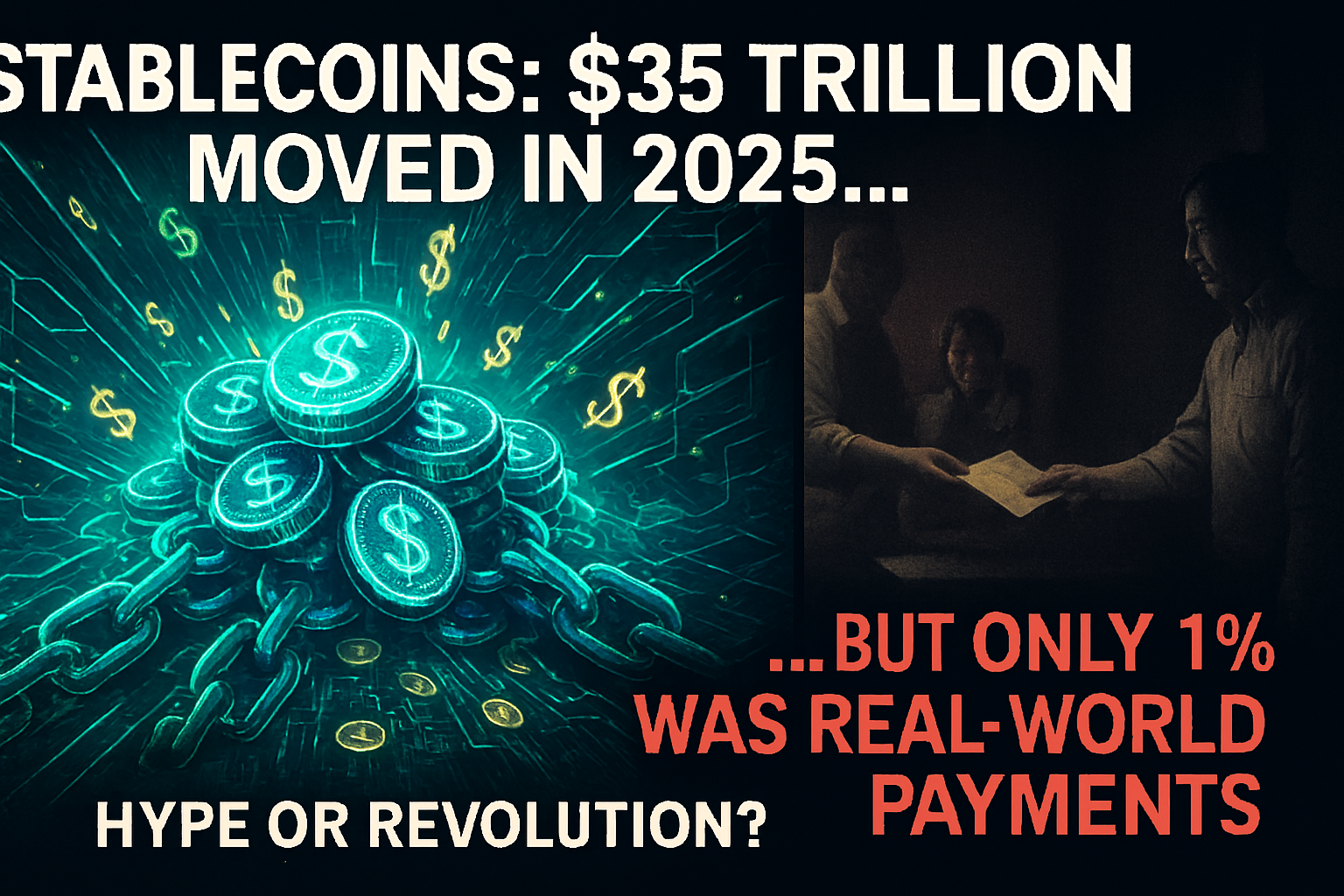
The numbers seem almost too staggering to believe: stablecoins processed approximately $35 trillion in transaction volume throughout 2025, a figure that dwarfs the annual GDP of most nations and rivals the combined output of the United States and China. Yet buried within this eye-popping headline lies a sobering reality that few mainstream outlets have properly examined—only about 1% of that colossal volume, roughly $380–390 billion, actually facilitated genuine real-world payments.
The remaining 99%? It’s a churning ocean of crypto trading, arbitrage, internal protocol transfers, and DeFi activity that never touches the “real economy” most of us inhabit. This isn’t merely a statistical footnote—it’s a fundamental tension that defines where stablecoins stand today and where they might head tomorrow.
The Illusion of Scale: Understanding What $35 Trillion Really Represents
When McKinsey and Artemis Analytics published their groundbreaking analysis examining 2025’s stablecoin transaction volume, they exposed something the cryptocurrency industry doesn’t often discuss candidly: raw on-chain volume tells an incomplete, even misleading story.
Think of it this way: if you withdraw $100 from an ATM, deposit it back into your account an hour later, then repeat this process ten times daily, you’ve generated $1,000 in “transaction volume” without actually purchasing anything. Stablecoins operate under similar dynamics, but at planetary scale.
The $35 trillion figure captures every movement of digital dollars like USDT, USDC, and their competitors across blockchain networks. This includes:
- Crypto exchange trading and liquidity provision: Traders using stablecoins as the “base currency” to buy Bitcoin, Ethereum, and thousands of altcoins
- Arbitrage operations: Sophisticated algorithms exploiting tiny price differences across exchanges, sometimes moving the same capital dozens of times per hour
- DeFi protocol interactions: Lending, borrowing, yield farming, and liquidity pool transactions that recirculate assets without ever converting to goods or services
- Internal custodial transfers: Exchanges and platforms shuffling assets between hot wallets, cold storage, and user accounts
As CoinDesk reported, this phenomenon isn’t unique to 2025, but the scale has grown exponentially. What matters for stablecoins real world payments adoption isn’t the headline number—it’s what happens when digital dollars leave the crypto ecosystem and enter the traditional economy.
Breaking Down the Real 1%: Where $390 Billion Actually Went
That $380–390 billion in genuine payments, while representing just a sliver of total volume, tells a far more interesting story. According to the McKinsey-Artemis breakdown, this real-world stablecoin transaction volume 2025 divided into several distinct categories:
Business-to-Business (B2B) Payments: $226 Billion
The largest segment involves companies using stablecoins for cross-border commercial transactions. A manufacturer in Vietnam receiving payment from a German distributor might prefer USDC settlement that arrives in minutes rather than waiting 3–5 days for traditional wire transfers that cost $25–50 in fees.
These transactions often involve:
- International trade finance
- Supply chain payments
- Corporate treasury management
- Cross-border invoice settlement
Remittances and Payroll: $90 Billion
Migrant workers sending money home have discovered stablecoins as an alternative to traditional remittance services that often charge 6–8% in fees. A construction worker in the UAE can now send USDT to family in the Philippines for pennies in transaction costs.
Similarly, global companies are experimenting with stablecoin-based payroll, particularly for remote contractors in emerging markets where accessing traditional banking infrastructure proves difficult or expensive.
Capital Markets Settlement: $8 Billion
Though still nascent, tokenized securities and institutional DeFi applications are beginning to use stablecoins for near-instantaneous settlement of trades that traditionally take T+2 days to clear.
Other Real-World Uses: $56–66 Billion
This catchall includes e-commerce purchases, bill payments, charitable donations, and various consumer transactions that convert stablecoins to fiat or goods and services.
Putting It in Perspective: The Vast Ocean of Global Payments
Here’s where the numbers become truly humbling. The global payments market processes over $2 quadrillion annually—that’s $2,000 trillion, or roughly 57 times larger than the total stablecoin on-chain volume and 5,100 times larger than stablecoins’ real-world payment contribution.
To put this in context: stablecoins currently represent approximately 0.02% of global payment flows. That’s two-hundredths of one percent.
Compare this to established players:
| Payment Network | Annual Volume (2025) | Market Share |
|---|---|---|
| Visa | ~$14 trillion | 0.7% of global payments |
| Mastercard | ~$9 trillion | 0.45% of global payments |
| SWIFT/Wire Transfers | ~$150 trillion | 7.5% of global payments |
| Stablecoins (Real Payments) | ~$390 billion | 0.02% of global payments |
The comparison reveals both the massive runway ahead and the enormous gap between current reality and crypto evangelists’ grander visions. As The Financial Times explored, stablecoins could theoretically shake up global payments—but “could” and “currently are” remain vastly different propositions.
Five Reasons Why Most Stablecoin Volume Isn’t “Real”
Understanding why 99% of stablecoin activity remains contained within crypto markets requires examining the structural dynamics of digital asset ecosystems:
1. Stablecoins Serve as Crypto’s Internal Plumbing
In traditional finance, the dollar functions as the reserve currency. In crypto markets, stablecoins play this role. When a trader wants to exit Bitcoin without converting to fiat, they sell for USDT or USDC. This creates enormous circular flows that inflate transaction counts without touching real-world commerce.
2. High-Frequency Trading Amplifies Apparent Activity
Algorithmic trading bots can execute hundreds of transactions per minute, moving between stablecoins and volatile assets. A single $1 million in capital might generate $50 million in daily volume through rapid-fire trades—yet this represents speculative positioning, not economic activity.
3. DeFi Protocols Require Constant Rebalancing
Automated market makers, lending protocols, and yield aggregators continuously move stablecoins between pools, strategies, and positions. These are legitimate financial operations but don’t represent new economic value creation or real-world payments.
4. Arbitrage Creates Volume Without Net Transfers
When USDC trades at $1.001 on one exchange and $0.999 on another, arbitrageurs pounce, moving millions to capture fractions of pennies. These transactions balance out crypto market inefficiencies but never exit the ecosystem.
5. Custodial Consolidation Inflates On-Chain Counts
Large exchanges periodically consolidate user funds from thousands of addresses into central treasuries, then redistribute them. Each movement registers as a transaction, multiplying the apparent volume.
The Regulatory Tailwind: How Policy Might Unlock Growth
Despite the current disparity between hype and stablecoin real economy adoption, 2026 has brought unprecedented regulatory clarity that could fundamentally shift these dynamics.
The GENIUS Act (Guiding and Establishing National Innovation for U.S. Stablecoins), passed in late 2025, established the first comprehensive federal framework for stablecoin issuers. Key provisions include:
- Reserve requirements: 1:1 backing with high-quality liquid assets
- Regular audits: Quarterly attestations by registered accounting firms
- Issuer licensing: Federal oversight for stablecoin providers
- Consumer protections: Redemption guarantees and disclosure requirements
As The Economist analyzed, this regulatory clarity removes a major barrier for institutional adoption. Banks and payment processors that previously avoided stablecoins due to legal uncertainty can now integrate them with defined compliance frameworks.
“Regulatory legitimacy is the bridge between crypto’s $35 trillion of internal volume and the $2 quadrillion real-world payment opportunity,” noted a recent McKinsey infrastructure report. The question isn’t whether institutions will adopt stablecoins, but how quickly traditional finance can integrate blockchain-based settlement rails.
Institutional Adoption: The Visa and Stripe Effect
The most consequential development in stablecoins vs traditional payments isn’t happening on crypto-native platforms—it’s occurring within legacy financial infrastructure.
Visa’s Stablecoin Settlement Network
In mid-2025, Visa announced it would enable merchants to receive settlement in USDC, initially for cross-border transactions. By year-end, over 8,000 merchants across 47 countries had activated this option. While Visa doesn’t disclose exact volumes, industry analysts estimate this accounted for roughly $12–15 billion of 2025’s real-world stablecoin payments.
The value proposition is straightforward: a coffee shop in Mexico City receiving payment from a tourist’s U.S. credit card can now get settled in USDC within hours rather than waiting days for traditional currency conversion and bank transfers. The shop then converts USDC to pesos through local exchanges at competitive rates.
Stripe’s USDC Payment Integration
Stripe’s decision to support USDC payments for its 4 million merchant partners potentially represents the largest single on-ramp for mainstream stablecoin payments growth. Early adoption has been modest—most customers still prefer traditional cards—but Stripe reported $8 billion in USDC payment processing throughout 2025.
The breakthrough moment may arrive when Stripe enables automatic stablecoin-to-fiat conversion at checkout, removing the cryptocurrency knowledge barrier. A customer paying with USDC wouldn’t need to understand blockchain technology any more than they need to understand ACH networks when paying with a bank account.
The Remittance Revolution That’s Actually Happening
While B2B payments grab headlines, stablecoin remittances payroll applications are delivering the most tangible human impact.
Traditional remittance services—Western Union, MoneyGram, and similar providers—charge average fees of 6.2% globally, according to World Bank data. For workers sending $200 home monthly, that’s $148.80 in annual fees, nearly a full month’s remittance lost to transaction costs.
Stablecoin alternatives charge $0.50–2 per transaction regardless of amount, representing 96–99% cost savings for many users. The $90 billion in remittances and payroll processed through stablecoins in 2025 likely saved senders approximately $5–6 billion compared to traditional channels.
Real-world adoption is concentrated in corridors where:
- Traditional banking infrastructure is weak or expensive
- Cryptocurrency literacy is growing
- Regulatory environments tolerate digital asset usage
- Local currency instability makes dollar-pegged assets attractive
Key corridors include U.S.-to-Mexico ($23B), UAE-to-Philippines ($14B), U.S.-to-Nigeria ($11B), and various Southeast Asian routes. These aren’t hypothetical use cases—millions of people are actively choosing stablecoins over legacy alternatives.
The Skeptic’s Case: Why 1% Might Be the Ceiling, Not the Floor
Balanced analysis demands examining why stablecoins real world payments might not dramatically expand beyond current levels. Several structural challenges complicate the bullish narrative:
Consumer Friction Remains High
Despite improved user interfaces, using stablecoins for everyday payments still requires:
- Setting up a digital wallet
- Understanding private key security
- Managing gas fees and network congestion
- Converting between crypto and fiat
- Tracking tax implications of each transaction
For most consumers in developed markets with efficient banking systems, this complexity offers little benefit. Venmo, Zelle, and instant bank transfers already provide fast, free, familiar payment experiences.
Merchant Adoption Lacks Incentive
Businesses operating on thin margins have little reason to adopt new payment rails that introduce operational complexity. Credit cards offer consumer protections and purchase financing that stablecoins don’t. The 2–3% merchant fee might be annoying, but it’s predictable and comes with dispute resolution.
Speculative Dominance Won’t Disappear
The crypto market’s fundamental nature—high volatility, 24/7 trading, global access—naturally generates enormous internal transaction volume. Even if real-world payment usage grows 10x, crypto trading activity might grow 20x, maintaining or even increasing the current disparity.
Regulatory Uncertainty Persists Globally
While the U.S. passed the GENIUS Act, China has banned crypto transactions entirely, the EU’s MiCA framework remains in implementation, and dozens of countries lack clear policies. A truly global payment network needs global regulatory harmonization—something that could take decades.
What 2026 and Beyond Might Bring
Despite these challenges, multiple credible forecasts project significant expansion. Various industry analyses suggest stablecoins could capture $2–4 trillion in real-world payment volume by 2030—roughly 5–10x current levels.
This growth would likely come from:
Institutional Adoption Cascades
As major banks, payment processors, and fintech companies integrate stablecoin rails, the network effects become self-reinforcing. When your bank, your employer, and your favorite retailers all accept USDC, the friction of adoption disappears.
Several major U.S. banks announced in late 2025 they would offer USDC custody and payment services in 2026, following regulatory approval. If Bank of America’s 68 million customers can send stablecoin payments as easily as Zelle transfers, adoption could accelerate dramatically.
Emerging Market Leapfrogging
Just as many developing nations skipped landline infrastructure and jumped directly to mobile phones, stablecoin adoption might surge in regions where traditional banking is weakest. When the choice is between a unreliable local bank charging high fees and a smartphone app offering instant dollar-denominated transfers, many will choose the latter.
Programmable Payment Innovation
Stablecoins enable payment capabilities impossible with traditional rails: automatic recurring payments, conditional escrow, instant cross-border settlement, and integration with smart contracts. As developers build applications leveraging these features, new use cases may emerge that drive organic adoption.
Tokenization of Real-World Assets
As securities, real estate, commodities, and other assets become tokenized, stablecoins serve as the natural settlement layer. A tokenized Treasury market alone could generate hundreds of billions in genuine stablecoin transaction volume.
The Measurement Problem: Separating Signal from Noise
One under-discussed issue is that as stablecoin adoption grows, distinguishing “real” from “speculative” volume becomes harder, not easier.
Consider a small business that accepts USDC payments, holds some reserves in stablecoin-denominated money market funds earning yield, and periodically rebalances between USDC and USDT based on liquidity needs. Are those rebalancing transactions “real world payments” or “crypto trading”?
As the line between DeFi and TradFi blurs—with institutional money market funds, tokenized securities, and blockchain-based trade finance—the very categories we use to evaluate stablecoin adoption may need rethinking.
Perhaps the more relevant question isn’t “What percentage is real-world payments?” but rather “How effectively are stablecoins serving as monetary infrastructure?” By that measure, even today’s 1% represents meaningful progress.
The Deeper Meaning: What This Really Tells Us
The $35 trillion versus $390 billion disparity isn’t a story of failure—it’s a snapshot of an immature financial technology finding its footing.
Every transformative payment innovation followed a similar pattern. Credit cards existed for decades serving primarily affluent consumers before becoming ubiquitous. PayPal spent years as a platform for eBay power sellers before becoming mainstream. Mobile payments were “always about to take off” for a decade before actually doing so.
The fact that 99% of stablecoin volume remains within crypto markets simply reflects where the technology currently finds its strongest product-market fit. Stablecoins solve real problems for crypto traders, DeFi users, and blockchain developers. They’re starting to solve real problems for remittance senders, cross-border businesses, and underbanked populations.
The trajectory matters more than the snapshot. If real-world stablecoin payments grow from $390 billion in 2025 to $600 billion in 2026, to $1 trillion in 2027, the percentage might still look insignificant—but the absolute impact would be transformative for millions of users.
A More Nuanced Future
The stablecoin narrative requires moving beyond binary thinking—beyond questions of whether they’ll “succeed” or “fail,” whether they’re “revolutionary” or “overhyped.”
The reality emerging from 2025’s data is that stablecoins have already succeeded at specific use cases: providing dollar liquidity in crypto markets, enabling efficient DeFi protocols, offering cost-effective remittances in certain corridors, and facilitating cross-border B2B payments for early adopters.
Whether they expand beyond these niches to challenge Visa, Mastercard, and traditional banking depends on factors still in flux: regulatory frameworks, institutional adoption pace, user experience improvements, and whether compelling consumer applications emerge.
The $35 trillion headline is impressive but misleading. The $390 billion reality is modest but meaningful. The gap between them represents both the challenge and the opportunity—a reminder that transforming global payments is measured in decades, not years, and that the distance between potential and practice remains vast.
For now, stablecoins are a powerful tool searching for mass-market purpose, having found genuine value in pockets of the global economy while still operating largely at the margins of mainstream finance. Whether that changes by 2030 may determine if we look back at 2025 as the beginning of a payment revolution or merely as another chapter in crypto’s long history of unfulfilled promises.
The most honest answer to “What does $35 trillion in stablecoin volume really mean?” might simply be: we’re still figuring it out—and that’s perfectly acceptable for a technology that’s barely a decade old attempting to reimagine infrastructure that took centuries to build.
Discover more from The CoinStar
Subscribe to get the latest posts sent to your email.

The “Super Bowl of Blockchain” and the “World Cup of Web3” is returning to the 852. After a massive, sold-out debut, Consensus Hong Kong 2026 is set to take over the city from February 10–12, 2026, bringing together the brightest minds in finance, technology, and policy.
Whether you are a developer looking for the next big protocol, an investor tracking $4 trillion in AUM, or a brand exploring the future of digital property, this is the place to be.
📍 Event Quick Facts
- Dates: February 10–12, 2026
- Venue: Hong Kong Convention & Exhibition Centre (HKCEC)
- Exhibition Hours: February 11–12, 2026
- Expected Attendance: 15,000+ attendees from 100+ countries
🚀 What to Expect in 2026
This year’s edition is even more ambitious, bridging the gap between Eastern and Western tech ecosystems. The 2026 agenda features over 100 high-caliber speakers across six stages, including leaders from Binance, Solana Foundation, Grayscale, and J.P. Morgan.
Dedicated Summits & Tracks:
- Open Money Summit: Deep dives into institutional adoption, ETFs, and tokenization.
- AI & Robotics Summit: Exploring the intersection of on-chain execution and AI agents.
- Global Bitcoin Summit: Focusing on infrastructure, layer-2 solutions, and monetary policy.
- DeFi & Stablecoins: Looking at the next evolution of decentralized finance for the masses.
Interactive Highlights:
- The Exhibition Floor (Feb 11-12): Discover 100+ fintech companies and 50+ crypto startups showcasing the latest in Web3 infrastructure.
- CoinDesk PitchFest: Watch the world’s most promising startups compete for funding and attention from top-tier VCs.
- EasyA Hackathon: A dedicated space for 650+ developers to build the next generation of decentralized apps.
🏙️ Beyond the Convention Center
Consensus isn’t just a conference; it’s a city-wide takeover. Expect over 350 side events across Hong Kong.
Don’t Miss: “The Consensus Cup” at the iconic Happy Valley Racecourse—a unique blend of high-stakes networking and Hong Kong’s legendary horse racing culture.
💡 Why Attend?
In a rapidly shifting regulatory landscape, Consensus Hong Kong serves as the Gateway to Asia. It is the premier venue for deal-making, offering unparalleled access to one of the world’s most rapidly scaling markets for crypto adoption.
Are you ready to shape the future of the digital economy? Register Now at the Official Consensus Site
Discover more from The CoinStar
Subscribe to get the latest posts sent to your email.
-

 AI4 months ago
The Chatbot Era is Over: Why OpenAI’s Pivot to Hardware with Foxconn Changes Everything
-

 AI5 months ago
The Top 10 Performing Crypto Coins in 2025: The Definitive Analyst Report on Price Potential, AI Integration, and Institutional Adoption
-

 Aviation4 months ago
Airbus A320 Recall: A Crisis of Confidence in Global Aviation
-

 AI3 months ago
Bitcoin Poised For ‘Boring’ 2025 Close – Here’s When BTC’s Real Test Will Come
-

 AI4 months ago
How AI-Driven Tokens Are Reshaping DeFi in 2025
-

 News4 months ago
Apple Pocket: The Most Controversial Tech Accessory
-

 Acquisition4 months ago
Daily Mail Owner Strikes £500m Deal for Telegraph Amid Regulatory Scrutiny
-

 Business4 months ago
Cloudflare Down: Twitter, ChatGPT, and Major Websites Hit by Global Internet Outage