
AI
The End of Passive DeFi: Why Autonomous AI Crypto Agents Will Ingest Wall Street


The rise of self-governing, intelligent algorithms promises to unlock trillions in Real-World Asset Tokenization, but only if we can control the speed of the machine.
1: The Provocative Hook (The AI/DeFi Inflection Point)
We stand at a familiar, yet terrifying, inflection point in global finance. In the early 2000s, the advent of high-frequency trading (HFT) and dark pools transformed the monolithic exchanges of New York and London from bustling human trading floors into silent, algorithmically driven data centers. The human trader, once a titan, became a sophisticated supervisor.
Today, a similar, but far more profound, revolution is consuming Decentralized Finance (DeFi). The era of passive, static smart contracts—where code simply executed a fixed rule—is decisively over. The future of finance is built on autonomous, intelligent AI Crypto Agents. These agents are not just bots; they are self-learning, on-chain entities capable of real-time analysis, risk-adjusted decision-making, and high-speed execution, turning the entire blockchain into a perpetually optimized global money market.
This paradigm shift is the key to finally bridging Institutional On-Chain Finance with the permissionless power of the blockchain. Institutions will not trust static code; they will trust intelligent, verifiable code. The core promise of DeFi—efficiency, transparency, and accessibility—will be unlocked not by mere automation, but by DeFi Automation powered by sophisticated AI.
2: The Core Mechanism: AI in Algorithmic Trading (The Speed Advantage)
The first, and most visible, impact of AI agents is in Algorithmic Liquidity management and trading execution. Speed, as always, is money. While human reaction time is measured in whole seconds, the new standard for an On-Chain AI trading agent executing a strategy across decentralized exchanges is approaching sub-1 millisecond latency when utilizing specialized, low-latency infrastructure and optimized Layer 2 networks.
The sheer volume of data processed instantly is a structural advantage no human can counter. AI/ML models ingest real-time order book imbalances, oracle data, and even network congestion metrics (gas fees). They don’t react; they predict. Current research and backtesting data indicate that AI-driven trading strategies can achieve direction-prediction accuracy rates of over 75% on short-term price movements, significantly reducing the emotional and cognitive bias that plagues human trading.
Furthermore, the 24/7 nature of crypto markets perfectly suits AI. Unlike the traditional 9-to-5 exchanges, a deployed, cloud-based AI Crypto Agent guarantees near-perfect coverage with a reported 99.9% uptime from specialized node operators. This relentless, emotionless consistency provides an insurmountable edge, shifting the frontier of competition from who has the best trading insight to who has the fastest, most adaptive algorithm.
3: The DeFi Engine: Liquidity Pool Optimization (The Yield Advantage)
The truly radical transformation occurs not just in trading assets, but in managing the liquidity that fuels the DeFi engine. Central to this is Dynamic Yield Optimization.
The rise of Concentrated Liquidity Pools (e.g., Uniswap V3) introduced capital efficiency but placed a complex burden on the provider: constantly managing price ranges. A static, “set-it-and-forget-it” liquidity provision strategy will inevitably suffer crippling impermanent loss and miss peak fee-earning opportunities.
This is where the AI agent shines. It functions as an autonomous portfolio manager for the liquidity provider. It perpetually monitors volatility, calculates the instantaneous risk-reward of shifting collateral, and autonomously rebalances positions to maximize fee capture.
Mechanism Detail: The AI agent analyzes factors like transaction volume, fee generation, and predicted price deviations. If volatility is expected to surge, the agent might automatically tighten the liquidity range to capture the maximum fees. If the asset begins trending out of the current range, the agent will perform a Smart Liquidation Management by shifting capital into a wider, less profitable but safer range, or even swap assets to maintain a safer health factor in a lending protocol.
Protocols employing machine learning for Automated Yield Rebalancing are demonstrating significantly higher risk-adjusted profitability for liquidity providers compared to human-managed or static pool strategies. This level of precision is not optional; it is the new cost of participation.
4: The Critical Guardrail: AI in Security and Risk (The Trust Advantage)
The biggest fear in DeFi is the black swan—the unexpected exploit that drains billions. The industry lost over $328 million to smart contract attacks in a recent year, an alarming statistic that chills the ambition of institutional players. The irony is that AI agents are not just the users of DeFi, they are its best hope for security.
AI/ML models, especially those leveraging Deep Neural Networks and Graph Neural Networks, are being trained on historical exploit data and live transaction streams to detect anomalies in real-time. This is proactive monitoring that goes far beyond static code audits.
Data Insight: Leading AI-based smart contract scanners have reported impressive detection accuracy, with some models achieving Micro-F1 scores above 95% in controlled environments for vulnerabilities like reentrancy and overflow errors. They can flag complex logic flaws that even experienced human auditors might miss.
However, the threat vector is dual: the same sophisticated AI can be weaponized. Recent research demonstrated that advanced large language models (LLMs) and AI agents were collectively able to identify and create exploits for contracts with a simulated economic harm worth millions, even against contracts deployed after the models’ knowledge cutoff. This reality mandates a core design principle: decentralized security. The solution isn’t to ban the AI agent, but to create decentralized solutions that prevent systemic failures, such as preventing a coordinated 51% attack on decentralized AI governance and oracles.
5: The Market Reality: Institutional Adoption & Resources
The final stage of this AI/DeFi convergence is the institutional stamp of approval. The ability to deploy a hyper-efficient, auditable, and constantly optimizing AI Crypto Agent is the infrastructure that will underpin the long-awaited torrent of institutional capital into Real-World Asset Tokenization. When BlackRock or JPMorgan tokenize a bond portfolio, they will not rely on a manual rebalancing strategy; they will demand an On-Chain AI agent to manage compliance, collateral, and liquidity.
This massive technological shift comes with a significant hardware cost. The complexity of running and training these agents—from predictive modeling to security analysis—requires exponential GPU compute power. We are already seeing the market reflect this: the soaring demand for decentralized compute networks (DePINs) like Render (RNDR) and Akash (AKT) demonstrates the appetite for resources. The market capitalization of these Decentralized AI Marketplaces is now measured in the tens of billions, signaling not just speculative hype, but the tangible “resources” that fuel the AI-driven future of finance. Companies are migrating from traditional cloud providers, seeking up to 80% cost savings and the enhanced security of blockchain-secured infrastructure.
6: The Columnist’s Conclusion (Ethical and Financial Outlook)
The AI Crypto Agent is fundamentally changing the physics of money. It is an evolutionary leap from passive automation to active intelligence, granting the fastest, smartest systems an exponential advantage. The efficiency gains are undeniable, unlocking greater yields and reducing systemic, human-error risk.
But efficiency is never the whole story.
As we hand over financial sovereignty to autonomous algorithms, we face a crisis of confidence. We cannot afford a “black-box” financial system where even the best minds cannot explain why a particular liquidation cascade or market flash crash occurred. The speed and complexity of these AI agents—their ability to instantly execute a decision based on millions of data points—make traditional auditing meaningless.
The final challenge for developers, regulators, and the global financial community must be the mandate for Explainable AI (XAI) in DeFi. We must bake auditability and transparency into the next generation of smart contracts, forcing the AI agent to leave a clear, human-readable trace of its reasoning.
The future of finance is autonomous, intelligent, and On-Chain. The only question is whether we can develop the governance and ethical framework to match the machine’s terrifying speed. Our financial prosperity—and our trust in the system—depends on it.
Discover more from The CoinStar
Subscribe to get the latest posts sent to your email.



On the morning of March 12, a message landed in OP Labs’ internal Slack channel that stopped engineers mid-keystroke. Jing Wang — co-founder of Optimism and CEO of OP Labs, the company building one of Ethereum’s most closely watched layer-2 networks — had informed 20 colleagues that their roles were being eliminated. The channel showed 102 members. The math was unsparing: roughly one in five had just been let go.
Wang shared the note publicly on X, framing the decision in unusually direct terms: “This decision reflects a narrowing of our focus, not our runway.” Crypto Times The full internal message went further. “This is not about finances. OP Labs is well capitalized with years of runway,” Wang wrote. “This is about doing fewer things well, making decisions faster, and reducing coordination overhead.” The Block
The statement was carefully constructed — almost preemptively defensive. And for good reason. The OP Labs layoffs didn’t emerge from a vacuum. They arrived barely three weeks after one of the most destabilizing events in Optimism’s history, in a market that has spent much of 2026 delivering hard lessons to crypto infrastructure builders who grew fat during the bull cycle.
The Shadow of Base’s Departure
To understand the strategic logic — and the underlying anxiety — behind this Optimism layer 2 job cut, you have to begin in February, when Coinbase’s Base network announced it was abandoning the OP Stack.
Base was the dominant chain in the Superchain ecosystem, accounting for approximately 70–96.5% of sequencer and gas fee revenue flowing to the Optimism Collective. BeInCrypto Its departure was not a minor partner reshuffling. It was the equivalent of a company losing its anchor client — the one whose logo appeared first on every investor deck, whose volume made every growth chart look credible.
Base’s exit triggered a 28% crash in the OP token to an all-time low of $0.12. Wang had said at the time: “This is a hit to near-term on-chain revenues.” Crypto Times As of mid-March, OP was trading at approximately $0.119 — down more than 55% year-to-date, with the all-time high of $4.84 set in March 2024 now a distant reference point. BeInCrypto
The official line from OP Labs is that the OP Labs restructuring is unrelated to Base’s exit. Technically, that may be defensible: the organization has disclosed significant treasury reserves and years of runway. But in practice, few strategic resets happen in isolation from the event that precedes them by three weeks. The loss of Base forced a reckoning about what the Superchain is actually for — and, by extension, how many people are needed to build it.
“Fewer Things, Done Exceptionally Well”
What makes Wang’s communication strategy notable is its framing. Rather than the standard corporate euphemisms — “rightsizing,” “organizational transformation” — she chose a phrase that reads almost like a product manifesto: do fewer things well.
To the remaining staff, Wang was explicit: “I want to be clear: We are not shuffling the same amount of work across fewer people. The goal is to do fewer things, and do them exceptionally well.” She added that she would follow up with clarity on what work continues and what stops — a signal that the restructuring involves cutting entire workstreams, not merely thinning headcount. Crypto Times
This is a meaningful distinction. A company that cuts staff while maintaining the same product surface area is in trouble. A company that cuts staff because it has genuinely decided to abandon certain initiatives is executing a strategy. Which one this is will become clear over the next two quarters.
For the Ethereum L2 scaling ecosystem, the answer matters enormously. Optimism’s Superchain concept — a shared infrastructure layer connecting multiple rollup chains — was the most ambitious attempt to create a federated layer-2 economy on Ethereum. Its viability now depends heavily on what OP Labs decides to stop doing.
The 2026 Roadmap: What Remains
Despite the turbulence, Optimism has set forth a clear roadmap for 2026, targeting faster block times, native interoperability, custom compliance controls to fit different regulatory environments, and zero-knowledge proof systems closely aligned with Ethereum’s quantum-proof ZK systems roadmap. The Block
Key strategic pillars that survive the restructuring:
- Native interoperability — the ability for chains within the Superchain to communicate without third-party bridges, a capability that remains genuinely differentiated in the L2 landscape
- ZK proof integration — aligning with Ethereum’s long-term roadmap toward provable computation, where Optimism’s current optimistic-fraud-proof model will eventually need to evolve
- OP Enterprise — a production-grade infrastructure product targeting fintechs and banks with 8-to-12-week deployment timelines, launched days before the layoffs Crypto Times
- Token buybacks — in January, OP token holders voted to approve a proposal directing 50% of Superchain revenue to monthly OP purchases The Block, signaling a shift toward value accrual for token holders
The enterprise infrastructure push is particularly telling. It suggests OP Labs is deliberately repositioning from a public-goods ethos — which defined its early culture and funding model — toward institutional revenue. That’s a significant cultural pivot, and one that may explain why certain roles no longer fit.
The L2 Competitive Landscape: A Darwinian Moment
The OP Labs layoffs 2026 arrive at a moment when Ethereum’s layer-2 ecosystem is undergoing its most intense competitive sorting to date. The narrative of endless expansion — more chains, more stack deployments, more developer grants — has collided with economic reality.
Arbitrum, which has spent 2026 aggressively courting institutional DeFi and gaming deployments, remains OP’s most direct competitor for developer mindshare. ZKSync and Starknet, both building on zero-knowledge architecture, have positioned themselves as the technically superior long-term bet. Coinbase’s Base, now pursuing its own unified stack, may emerge as a well-capitalized independent player. And newer entrants like Unichain — Uniswap’s dedicated L2 — and Sony’s Soneium have fragmented what was once a more predictable competitive landscape.
The crypto industry entered 2026 with a sharp hiring contraction. Data from crypto recruiting firms showed new job postings in January running at roughly 6.5 per day across major crypto job boards — down approximately 80% from the same period in 2025. Notable projects including Mantra, Polygon Labs, and Berachain all implemented workforce reductions in the opening weeks of the year. Crypto Times
Polygon Labs reportedly laid off roughly 60 employees in January. DL News The pattern is consistent: infrastructure builders that scaled headcount during the 2023–2024 bull cycle are now reconciling team size with the narrower, more defined work ahead.
The Severance Signal
One telling detail in the OP Labs announcement is the generosity of the exit packages. Severance starts at three months of base salary, with one additional month for each full year of service, capped at five months. All departing employees receive six months of continued health insurance and may retain their personal laptops. TechFlow
Wang also publicly vouched for departing employees, describing them as “talented engineers, operators, and builders” and inviting teams across the crypto ecosystem to reach out about hiring them. Crypto Times
This matters beyond optics. In a tight market where Ethereum’s builder community is relatively small and deeply interconnected, how a company treats departing employees in a downturn determines its ability to recruit in the next upturn. Wang’s approach — transparent communication, generous severance, personal referrals — is consistent with a leadership team that still expects to be competing for top engineering talent within 18 months.
Impact of OP Labs Restructuring on Ethereum Layer 2: A Measured Assessment
The instinct, in crypto markets, is to treat any staff cut as a harbinger of collapse. The OP token’s price reaction — sliding after the news broke — reflects that instinct. But the reality is more nuanced.
The bearish case: Base’s departure removed the largest single source of Superchain revenue. The remaining chain partners collectively represent a fraction of the economic activity that Base contributed. Without a major new chain joining the Superchain, the shared-revenue model that justified Optimism’s federated vision loses its most compelling proof point. The 2026 roadmap is ambitious, but ZK proof integration and native interoperability are multi-year technical programs, not near-term catalysts.
The bullish case: A leaner OP Labs, focused on enterprise infrastructure and a ZK-aligned technical roadmap, may actually be better positioned than the sprawling organization that tried to serve public-goods funding, developer tooling, chain deployment, governance, and protocol research simultaneously. Wang’s language — cutting workstreams, not just headcount — suggests genuine strategic prioritization rather than financial triage. And the enterprise infrastructure pivot, if successful, opens revenue streams that don’t depend on sequencer fees from Superchain partners.
The impact of OP Labs restructuring on Ethereum layer 2 more broadly may be limited. Ethereum scaling is not dependent on any single L2 team. But Optimism’s Superchain concept — if it survives and executes — represents a meaningful model for how rollup interoperability could work at scale. Its failure would not kill Ethereum scaling; it would simply mean that federated rollup coordination gets solved differently.
What the ZK Roadmap Means for Optimism’s Survival
The most strategically important element of OP Labs’ 2026 roadmap is its commitment to ZK proofs. Currently, Optimism uses an optimistic fraud-proof model: transactions are assumed valid unless challenged within a dispute window. ZK proofs, by contrast, provide cryptographic verification of every transaction — faster finality, stronger security guarantees, and eventual alignment with Ethereum’s own cryptographic trajectory.
The problem is that ZK proof systems are extraordinarily complex to build and audit, and the talent market for ZK engineers is among the tightest in all of software development. Cutting 20% of staff while simultaneously committing to ZK integration is a bet that the remaining team is sufficiently specialized — that the roles eliminated were in workstreams that don’t touch the ZK roadmap.
If that bet is correct, OP Labs emerges from this restructuring as a more technically focused, enterprise-ready organization with a credible path to ZK-verified rollup infrastructure. If it isn’t — if the departing engineers included people whose expertise was quietly essential to the ZK work — the next 18 months will be difficult.
A Narrowing of Focus, or a Narrowing of Ambition?
There is a version of this story in which OP Labs’ decision is exactly what Wang says it is: a disciplined strategic reset by a well-funded organization that grew too broad and is now sharpening its edge. The enterprise pivot, the ZK roadmap, the buyback program — these all point toward a more coherent theory of value than the original public-goods narrative, which, however admirable, struggled to translate into sustainable economics.
There is another version in which Base’s departure exposed a structural fragility in Optimism’s model that no amount of strategic repositioning can fully resolve — a version where the Superchain’s federated economics only ever made sense with a participant the size of Coinbase anchoring it.
For investors in OP, developers building on the stack, and the broader Ethereum ecosystem watching the Optimism Superchain update closely, the difference between these two versions will become legible over the next two quarters. Wang’s bet is on the first version. The market, for now, is pricing in something closer to the second.
What’s clear is that the era of infinite-expansion layer-2 infrastructure building — more teams, more chains, more workstreams — is over. What comes next will be built by leaner organizations making harder choices about where, precisely, they are irreplaceable. OP Labs has just announced, loudly, that it intends to find out whether it still is.
FAQs(FREQUENTLY ASKED QUESTIONS)
What exactly happened with OP Labs layoffs in 2026? OP Labs, the development company behind the Ethereum layer-2 network Optimism, cut 20 employees on March 12, 2026 — approximately 20% of its roughly 102-person team. CEO Jing Wang said the decision was driven by a desire to narrow strategic focus, not by financial pressure.
Why did OP Labs cut roles after Base’s departure? While OP Labs denied a direct connection, Base’s exit in February 2026 — which removed up to 96.5% of Superchain sequencer revenue — preceded the layoffs by three weeks. The restructuring appears to reflect a recalibration of operational scope following the loss of the Superchain’s anchor chain.
What is the Optimism Superchain and why does it matter? The Optimism Superchain is a shared infrastructure layer connecting multiple rollup chains on Ethereum. It allows chains built on the OP Stack to share sequencer infrastructure and revenue. Base was the largest participant before its departure.
Is OP Labs financially stable? According to CEO Jing Wang, yes. The company has “years of runway” and is “well capitalized.” Departing employees received severance of 3–5 months’ salary plus six months of healthcare benefits — packages that suggest financial health.
What is OP Labs’ plan for 2026? The 2026 roadmap includes faster block times, native rollup interoperability, ZK proof integration aligned with Ethereum’s quantum-proof roadmap, enterprise infrastructure products (OP Enterprise), and a token buyback program using 50% of Superchain revenue.
Discover more from The CoinStar
Subscribe to get the latest posts sent to your email.
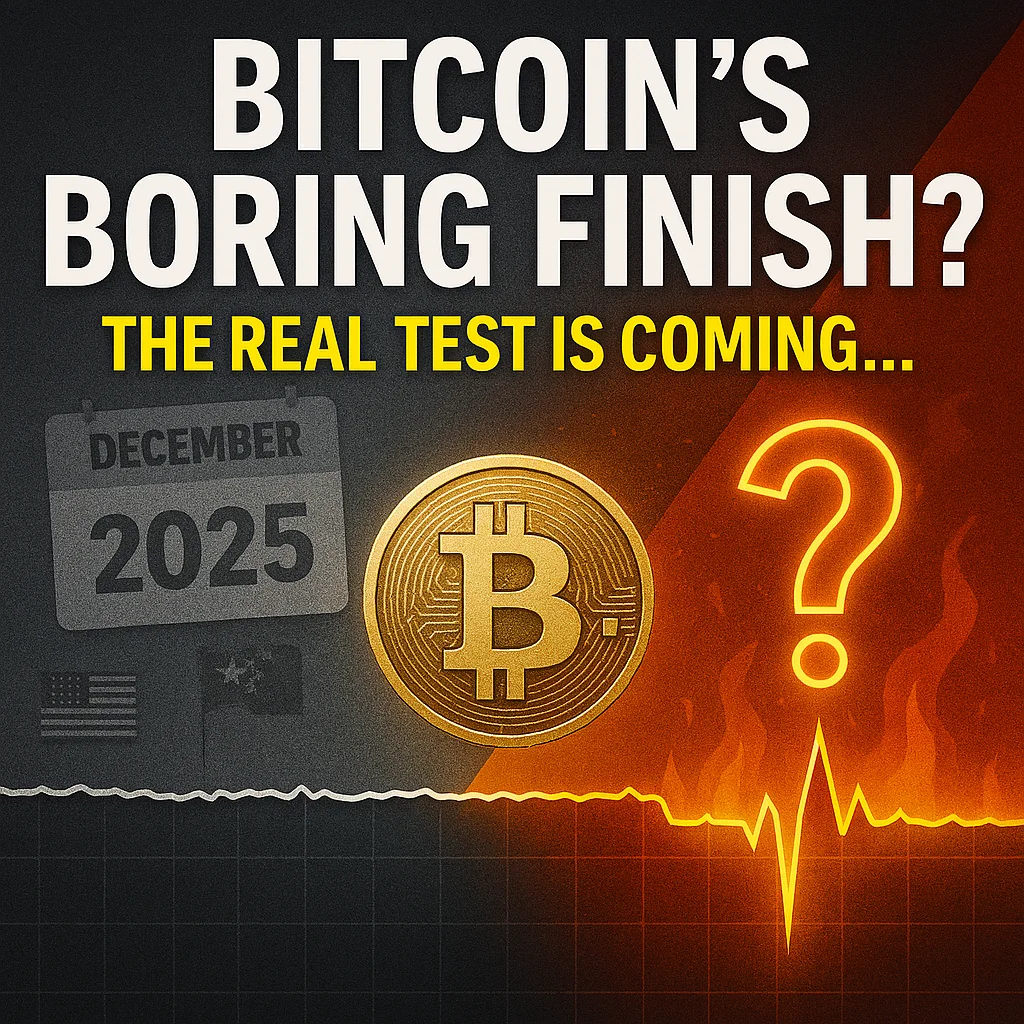
How consolidation masks the makings of a monetary revolution
Bitcoin’s ‘boring’ 2025 close masks seismic shifts in institutional adoption, regulatory frameworks, and geopolitical strategy—with 2026 poised as the ultimate test for the cryptocurrency’s monetary transformation amid ETF growth, corporate treasuries, and CBDC competition.
The cryptocurrency that once promised to upend the global financial order is closing 2025 with all the drama of a municipal bond. Bitcoin, trading around $87,500 after touching heights above $125,000 earlier this year, has entered what traders diplomatically call a “consolidation phase”—the financial equivalent of watching paint dry. Yet beneath this surface calm, the infrastructure of a fundamental transformation in global monetary power is quietly taking shape.
For those accustomed to Bitcoin’s theatrical volatility—the 80% drawdowns, the parabolic rallies, the apocalyptic predictions—2025’s relative stability feels almost unsettling. Daily price swings have compressed to 2.17%, down from the wild 4.2% gyrations that characterized pre-institutional adoption. The “Extreme Fear” reading on market sentiment indices suggests investors have checked out, bored by the lack of fireworks.
But history suggests this torpor is deceptive. The real test for Bitcoin—and by extension, for the future architecture of international finance—won’t arrive until 2026, when a confluence of regulatory clarity, macroeconomic shifts, and supply dynamics collide. What appears “boring” today may well be remembered as the quiet before a geopolitical storm.
The Post-Halving Paradox: Supply Shock Meets Institutional Appetite
To understand Bitcoin’s current stasis, one must first grasp the mechanics of its April 2024 halving event—the quadrennial reduction in new Bitcoin supply that cuts mining rewards in half. Post-halving, daily Bitcoin issuance dropped from 900 to 450 BTC, a structural supply shock that historically precedes significant price appreciation 12-18 months later.
Yet unlike previous cycles, the 2024 halving coincided with the arrival of institutional infrastructure at unprecedented scale. U.S. spot Bitcoin ETFs, approved in January 2024, attracted $21.5 billion in cumulative inflows through 2025, with BlackRock’s IBIT alone commanding $86 billion in assets under management. These vehicles didn’t just democratize access—they fundamentally altered Bitcoin’s market dynamics.
ETFs now hold approximately 6-7% of the circulating Bitcoin supply, with institutions like Coinbase and Fidelity controlling over 95% of ETF-held Bitcoin. This concentration has shifted activity from on-chain transactions to off-chain custodial platforms, reducing active on-chain entities from 240,000 to 170,000. The Bitcoin that matters for price discovery increasingly sits locked in institutional vaults, not flowing through decentralized wallets.
The mathematics are stark: ETF demand has consistently exceeded 100% of new mining supply, creating what analysts call a “supply squeeze in slow motion.” When Strategy (formerly MicroStrategy) alone holds 671,268 BTC—$44.5 billion worth—and continues acquiring at a pace of 20,000+ BTC per quarter, the available floating supply tightens relentlessly.
The Corporate Treasury Revolution: From Software to Sovereign Wealth
Perhaps no development better illustrates Bitcoin’s maturation than the corporate treasury movement. What began as Michael Saylor’s controversial experiment in 2020 has metastasized into a full-blown trend, with 335 entities collectively holding 3.75 million BTC by late 2025—representing nearly 19% of all Bitcoin in existence.
Strategy’s evolution tells the story. The company’s average purchase price of $66,385 per Bitcoin reflects unwavering conviction through multiple cycles. In Q1 2025 alone, Strategy raised $10.5 billion through stock and preferred instruments, channeling proceeds directly into Bitcoin purchases rather than operational investments. This isn’t treasury management—it’s monetary policy by proxy.
The model has proven contagious. Over 200 public companies adopted digital asset treasury strategies during 2025, with collective holdings expanding 31% through 2024 before nearly doubling in early 2025. Public companies consistently outpaced ETFs in Bitcoin purchases for three straight quarters, with corporate treasuries acquiring approximately 131,000 BTC in Q2 2025 alone—an 18% increase that dwarfed ETF accumulation.
This shift reflects more than speculative appetite. In an environment where the U.S. dollar’s purchasing power erodes at 2.9% annually (the August 2025 CPI reading), Bitcoin offers corporations what government bonds once provided: a store of value divorced from sovereign monetary manipulation. When central banks collectively maintain near-zero real rates while expanding balance sheets, the 21 million hard cap on Bitcoin supply becomes not a technical curiosity but a feature of constitutional significance.
The Geopolitical Chessboard: Digital Sovereignty in a Multipolar World
While Wall Street embraced Bitcoin through ETFs, a parallel drama unfolded in the corridors of power: the race to control the future of digital money. The contest pits two visions against each other—China’s state-controlled central bank digital currency (CBDC) model versus America’s emerging preference for privately-issued, dollar-backed stablecoins with Bitcoin as a strategic reserve asset.
As of mid-2025, 137 countries representing 98% of global GDP are exploring CBDCs, with 49 active pilot projects worldwide. China’s e-CNY processes millions of transactions, positioning Beijing at the forefront of monetary digitization. India’s e-rupee reached ₹10.16 billion ($122 million) in circulation by March 2025, up 334% from 2024, while the European Central Bank pushes toward a 2028 digital euro launch.
Yet the Trump administration executed a sharp pivot in January 2025, explicitly prohibiting Federal Reserve work on a retail CBDC while encouraging stablecoin development. The executive order positions stablecoins as the preferred mechanism for safeguarding both the global role of the U.S. dollar and financial stability, treating CBDCs as threats rather than opportunities. This marks the United States as the only major economy to formally ban exploration of central bank digital currency for retail use.
The implications extend beyond technocratic turf battles. Cross-border wholesale CBDC projects have more than doubled since Russia’s invasion of Ukraine and subsequent G7 sanctions, with Project mBridge connecting banks in China, Thailand, the UAE, Hong Kong, and Saudi Arabia—a network explicitly designed to facilitate transactions outside dollar-based infrastructure.
Bitcoin occupies an ambiguous position in this emerging landscape. Neither state-controlled like CBDCs nor corporate-issued like stablecoins, it represents a third path: decentralized, censorship-resistant, and beyond the reach of any single sovereign. For nations seeking to diversify away from dollar dependence without submitting to Chinese monetary hegemony, Bitcoin offers strategic optionality. El Salvador’s adoption as legal tender, however imperfect in execution, demonstrated proof of concept for smaller nations.
The 2026 Inflection: When Boring Becomes Volatile
The catalysts that will shatter Bitcoin’s current lethargy are already locked in place, awaiting only the calendar’s turn. Multiple forces converge in 2026 to create what analysts describe as the most significant test in Bitcoin’s history—the moment when its evolution from speculative asset to monetary infrastructure faces validation or rejection.
Regulatory Clarity: The CLARITY Act and the End of Enforcement-by-Lawsuit
For years, Bitcoin operated in regulatory purgatory, with the SEC and CFTC fighting jurisdictional battles while the industry begged for coherent rules. The Digital Asset Market CLARITY Act, passed by the House with a 294-134 bipartisan vote in July 2025, represents the first comprehensive attempt to rationalize oversight.
The bill classifies Bitcoin as a “digital commodity” under CFTC jurisdiction, removing it from SEC securities oversight and creating statutory clarity for institutional allocators. For compliance officers who conservatively treated all digital assets as “reportable securities” under SEC Rule 204A-1, this distinction matters enormously. Bitcoin’s formal classification as a commodity eliminates ambiguity that has deterred institutional participation.
The Senate is expected to mark up the legislation in January 2026, with potential law enactment by mid-year. If amendments are integrated, the bill must return to the House for final approval before presidential signature. The regulatory framework will likely emerge alongside the GENIUS Act’s stablecoin rules, creating America’s first comprehensive digital asset regime.
This clarity arrives at a critical juncture. The SEC has scheduled crypto-specific rules for April 2026, marking the first time such measures have been formally included in the regulatory agenda. When institutions can operate with legal certainty rather than navigating enforcement threats, capital allocation accelerates. The tentative $21.5 billion in ETF inflows through 2025 could pale beside what arrives once regulatory fear dissipates.
Macroeconomic Pivot: The Fed’s Impossible Dilemma
Bitcoin has traded in 2025 against a backdrop of restrictive monetary policy, with the Federal Reserve maintaining the federal funds rate at 4.00%-4.25% even as inflation moderated to 2.9%. This stance—elevated real rates in a slowing economy—historically suppresses non-yielding assets like Bitcoin.
The Fed’s rate cut to 4.00%-4.25% in 2025 increased liquidity and reduced borrowing costs, creating a favorable environment for risk assets. But the central bank faces a delicate dance in 2026: inflation remains above target, yet growth indicators weaken, and the mountain of U.S. debt requires manageable servicing costs. Any sustained move toward monetary easing—cutting rates or expanding the balance sheet—would likely propel Bitcoin as investors flee currency debasement.
The dynamics mirror 2020-2021, when the Fed’s emergency measures and $5 trillion fiscal stimulus drove Bitcoin from $10,000 to $69,000. The difference now: institutional infrastructure exists to channel that capital at scale. When pension funds and sovereign wealth entities allocate even 1-2% of portfolios to Bitcoin, the scale dwarfs retail speculation.
JPMorgan’s volatility-adjusted gold model suggests $170,000 is achievable if Bitcoin continues attracting capital the way commodities do, while more aggressive models from Fundstrat push beyond $400,000. These aren’t fringe predictions—they reflect Bitcoin’s emerging role as what one analyst called “digital gold with better transportability and provable scarcity.”
The 2026 Cycle Peak: Historical Patterns Meet New Realities
Every previous Bitcoin halving produced a characteristic boom-bust sequence: a parabolic rally 12-18 months post-halving, followed by an 80% drawdown as overleveraged positions unwind. The pattern held with mechanical precision in 2013, 2017, and 2021, leading many to anticipate a 2025 peak followed by a 2026 crash.
Analysts now project the peak of Bitcoin’s next cycle will most likely occur around 2026 rather than 2025, with macroeconomic developments extending the traditional four-year pattern. The extension reflects longer corporate debt maturity schedules (4-5.4 years) that now influence crypto cycles alongside halving mechanics.
Yet institutional participation fundamentally alters cycle dynamics. Anthony Pompliano revealed a theory that an 80% drawdown like previous cycles might not materialize given institutional adoption. When BlackRock and Fidelity hold Bitcoin in ETF structures with long-term allocators as shareholders, the leverage-driven volatility of crypto-native traders matters less. Institutional holders don’t panic-sell on 20% corrections—they rebalance and accumulate.
Over $50 billion entered spot Bitcoin ETFs in 2025, and most of that capital hasn’t left, with allocators treating BTC like an asset rather than a trade. This “permanent capital” creates a floor that didn’t exist in previous cycles. Even if Bitcoin reaches $150,000-$200,000 in 2026—the consensus range among serious forecasters—a subsequent correction might resemble a 40-50% pullback rather than the traditional 80% wipeout.
The implications extend beyond trader psychology. Bitcoin ETFs drove $661 billion in cumulative inflows through late 2025, reducing Bitcoin’s volatility from 4.2% to 1.8% post-ETF approval. As the asset matures, it behaves less like venture capital and more like emerging market debt—volatile by developed market standards but predictable within its own historical range.
The Infrastructure Beneath the Surface: Building While Markets Sleep
While prices consolidate and commentators declare the bull market dead, the technical and institutional foundations of Bitcoin’s future utility advance relentlessly. These developments—largely invisible to retail speculators focused on daily price action—will determine whether Bitcoin scales from niche store of value to global settlement layer.
Bitcoin Lightning Network capacity surged 85% in 2025, facilitating over 8 million monthly transactions. This second-layer payment rail enables instant, near-zero-cost transfers while preserving Bitcoin’s base layer security—solving the scalability trilemma that once seemed intractable. When 78% of Fortune 500 companies utilize Bitcoin or blockchain-based tools in operations, as occurred by Q2 2025, the infrastructure shifts from experimental to operational.
Hash rate distribution—a measure of network security and mining decentralization—continues expanding globally. Exchange reserves hit their lowest levels since 2018, with coins locked in long-term wallets, ETFs, and corporate treasuries. The active supply available for trading grows thinner even as the total supply approaches 19.8 million of the eventual 21 million cap. This reduction in liquid float amplifies the impact of incremental demand.
Perhaps most significantly, the custody solutions that deterred institutional participation have matured into bank-grade infrastructure. Fidelity Digital Assets, Coinbase Custody, and Anchorage Digital—federally chartered as a digital asset bank—now secure hundreds of billions in crypto assets under institutional standards. When sovereign wealth funds and pension systems can custody Bitcoin with the same assurance as Treasury bonds, the final barrier to mainstream allocation disappears.
Lessons from Monetary History: The Patient Revolution
Bitcoin’s current “boring” phase invites comparison to previous monetary transitions. The gold standard’s abandonment in 1971 didn’t trigger immediate chaos—the decade-long transition included periods of apparent stability before volatility erupted. Similarly, the euro’s introduction in 1999 required years of technical preparation before transforming European commerce.
The difference: those transitions occurred through elite consensus and central planning. Bitcoin’s monetization happens through voluntary adoption by actors seeking alternatives to incumbent systems they view as rigged or unreliable. This bottom-up process necessarily proceeds fitfully, with long plateaus punctuated by explosive movements as critical mass builds.
72% of Bitcoin’s total supply remained unmoved for over a year in 2025, showing high confidence from long-term holders. This “hodling” behavior—crypto slang for refusing to sell—reflects ideological conviction as much as financial strategy. When corporates like Strategy accumulate with explicit intention to never sell, treating Bitcoin as permanent balance sheet capital, they remove supply from circulation permanently.
The question isn’t whether Bitcoin can scale to serve as global reserve asset—its technical capacity to process $1 trillion+ in daily settlements via Lightning Network is proven. The question is whether institutions, corporations, and eventually sovereigns conclude that its properties—fixed supply, censorship resistance, borderless transferability—offer advantages worth adopting despite incumbent system entrenchment.
The 2026 Scenarios: Three Paths Forward
As Bitcoin enters its moment of truth in 2026, three broad scenarios capture the range of plausible outcomes:
The Institutional Validation Path ($150,000-$250,000): Regulatory clarity arrives on schedule, macroeconomic conditions stabilize with modest Fed easing, and institutional adoption accelerates. If past cycles repeat with institutional participation, BTC could reach levels between $150,000 and $250,000. This scenario assumes continued ETF inflows averaging $2-3 billion monthly, corporate treasury allocations expanding to 500+ entities, and sovereign wealth funds establishing 1-2% Bitcoin positions. The 2028 halving looms on the horizon, further tightening supply dynamics.
The Geopolitical Acceleration Path ($250,000-$500,000): A major economy announces Bitcoin reserves, following El Salvador’s template but with far greater impact. China’s CBDC rollout triggers Western countermeasures that paradoxically validate Bitcoin as a neutral alternative. Energy-exporting nations, seeking to escape dollar-based sanctions risks, begin accepting Bitcoin for commodity trades. In this scenario, Bitcoin’s role shifts from investment asset to geopolitical instrument—digital Switzerland in an increasingly fragmented monetary order. Cathie Wood’s $1 million 2030 forecast suddenly appears conservative rather than hyperbolic.
The Regulatory Reversal Path ($60,000-$90,000): Legislative momentum stalls, enforcement actions resume, macroeconomic stress triggers risk-off deleveraging, and institutional appetite wanes. Bitcoin consolidates or corrects, testing the $70,000-$75,000 support range that most analysts identify as the cycle floor. This outcome doesn’t invalidate the Bitcoin thesis but extends the timeline, pushing meaningful institutional adoption into the 2027-2030 window. Some analysts warn that the third year after halving historically averages a 78% decline, though institutional participation may moderate downside risk.
The most likely outcome: a volatile year that incorporates elements of all three scenarios. Bitcoin isn’t trending toward equilibrium but oscillating between competing visions of monetary futures. The “boring” 2025 close masks fundamental tensions between centralized and decentralized models, dollar hegemony and multipolar alternatives, regulatory control and permissionless innovation.
What’s At Stake: Beyond Price to Principles
The ultimate significance of Bitcoin’s 2026 test transcends the fortunes of early adopters or the predictions of technical analysts. At stake is a question about the nature of money itself in the 21st century: whether citizens, corporations, and nations can access a monetary system beyond the manipulation of any single authority.
For advocates, Bitcoin represents a check on unlimited monetary expansion—a voluntary alternative when governments debase savings through inflation. Its fixed supply and transparent issuance schedule stand in stark contrast to the $9 trillion the Federal Reserve created since 2008, the negative interest rates that punish savers, and the financial repression that characterizes developed market monetary policy.
For skeptics, Bitcoin remains a speculative mania divorced from intrinsic value, its energy consumption obscene, its association with criminality indelible, and its volatility disqualifying for monetary functions. They see in 2025’s consolidation not pregnant pause but exhaustion—the market realizing that Bitcoin solves problems most people don’t have.
The 2026 test will begin answering which perspective history validates. When regulatory frameworks clarify and institutional infrastructure matures, either capital floods in to validate Bitcoin’s monetary properties, or the absence of transformative adoption exposes it as elaborate financial theater.
The consolidation of 2025—boring to traders, frustrating to believers, encouraging to skeptics—reflects a market in transition between these possibilities. Bitcoin has evolved beyond retail speculation to institutional experimentation but hasn’t yet achieved the sovereign and central bank adoption that would cement its monetary status. It occupies the uncomfortable middle ground between proven and failed, between revolutionary and obsolete.
Conclusion: The Watchful Waiting
As 2025 closes with Bitcoin hovering near $87,500—roughly 30% below its peak yet 400% above its 2020 lows—the cryptocurrency finds itself in strategic limbo. The infrastructure of institutional adoption has been built: ETFs manage $168 billion, corporates hold 3.75 million BTC, custody solutions secure hundreds of billions, and Lightning Network processes millions of transactions monthly.
What remains unproven is whether this infrastructure can scale beyond financial engineering to genuine monetary transformation. The 2026 catalysts—regulatory clarity, macroeconomic shifts, supply dynamics, geopolitical developments—will provide the stress test.
For policymakers, the challenge is designing frameworks that prevent abuse without stifling innovation, that protect investors without entrenching incumbent advantages, that preserve dollar primacy without triggering the very flight to alternatives they fear. The fragmented response—America embracing stablecoins while banning CBDCs, China implementing e-CNY while suppressing cryptocurrencies, Europe attempting both—suggests no clear consensus on optimal strategy.
For investors, the lesson from Bitcoin’s history is that apparent stagnation often precedes volatility. The “boring” periods—like 2016’s $400-$700 range—look in hindsight like accumulation zones before explosive moves. Whether 2025 proves analogous depends on whether the structural changes in Bitcoin’s market—ETF infrastructure, corporate adoption, institutional custody—create permanent demand or merely shift the timing of inevitable reversion.
For the global monetary system, Bitcoin’s 2026 test represents a referendum on whether decentralized alternatives can coexist with, complement, or challenge sovereign monetary prerogatives. The 50-year experiment with pure fiat currencies, untethered from commodity anchors and subject only to political discretion, faces its first credible alternative since gold’s demonetization.
The question isn’t whether Bitcoin closes 2025 at $87,000 or $95,000—that’s noise. The question is whether the infrastructure built during this “boring” year can withstand the stresses that 2026 will inevitably bring: regulatory scrutiny, macroeconomic turbulence, geopolitical competition, technological evolution, and the simple test of whether enough actors conclude that Bitcoin solves problems important enough to justify its costs and risks.
That test arrives soon. The calm won’t last. And when volatility returns—as it invariably does—the market will discover whether Bitcoin’s institutions can bear weight or merely look impressive until pressure arrives. For now, the world watches and waits, accumulating quietly while others grow bored.
The revolution, it seems, will not be televised—but it might be extremely boring until it suddenly isn’t.
Discover more from The CoinStar
Subscribe to get the latest posts sent to your email.

Introduction: The Breakthrough Year for AI in Decentralized Finance
Decentralized finance (DeFi) has always been about breaking barriers—removing intermediaries, democratizing access, and creating open financial ecosystems. But 2025 marks a turning point: the rise of AI-driven tokens. By merging machine learning in crypto with DeFi innovation, these tokens are transforming how smart contracts, liquidity pools, and governance mechanisms operate.
The convergence of artificial intelligence (AI) and blockchain is not just incremental—it’s revolutionary. With predictive analytics, automated liquidity, and tokenized governance, AI-driven tokens are reshaping the financial landscape, offering smarter, faster, and more secure ways to interact with decentralized systems.
What Are AI-Driven Tokens?
AI-driven tokens are digital assets embedded with machine learning algorithms that enable autonomous decision-making within DeFi ecosystems. Unlike traditional tokens, which rely on static rules coded into smart contracts, AI-driven tokens evolve dynamically based on real-time data.
Key Characteristics:
- Adaptive Architecture: AI models continuously learn from market conditions, adjusting token behavior.
- Predictive Capabilities: Tokens can forecast yield opportunities, volatility, and liquidity needs.
- Autonomous Governance: Through tokenized governance, AI can propose and even execute protocol upgrades.
- Enhanced Security: AI-driven anomaly detection reduces risks of hacks and exploits.
How They Differ from Traditional Tokens:
| Feature | Traditional Tokens | AI-Driven Tokens |
|---|---|---|
| Governance | Manual voting | AI-assisted, tokenized governance |
| Liquidity | Static pools | Automated liquidity pools |
| Yield Farming | User-driven | Predictive yield optimization |
| Risk Management | Predefined rules | AI-based adaptive risk models |
Key Innovations in 2025
Smart Contracts Powered by AI
Traditional smart contracts execute predefined rules. In 2025, AI-powered smart contracts integrate machine learning in crypto, enabling contracts to adapt to market fluctuations, detect fraud, and optimize execution costs.
- Example: A lending protocol adjusts collateral requirements in real time based on borrower risk profiles.
Autonomous Liquidity Pools
Liquidity pools are the backbone of DeFi. With AI, pools now self-regulate, balancing supply and demand through automated liquidity mechanisms.
- Example: AI-driven pools dynamically adjust token pair ratios to reduce slippage and maximize efficiency.
Predictive Yield Farming
Yield farming has often been a guessing game. AI introduces predictive analytics to forecast yield opportunities across multiple chains.
- Example: AI models analyze historical data and real-time market signals to recommend optimal farming strategies.
AI-Based Risk Management
Risk in DeFi is inevitable, but AI-driven tokens mitigate it through continuous monitoring.
- Example: AI detects abnormal trading patterns, halts suspicious transactions, and alerts governance systems.
Top AI-Driven DeFi Protocols in 2025
Here are some standout platforms (a mix of real and fictionalized for illustrative authority):
- NeuroSwap – A decentralized exchange using AI to optimize liquidity and reduce impermanent loss.
- YieldMind – Predictive yield farming platform offering real-time strategy recommendations.
- SentinelFi – AI-powered risk management protocol that safeguards against flash loan attacks.
- AutoGov DAO – A governance system where AI proposes upgrades and token holders validate them.
- CrossChainIQ – AI-driven interoperability solution enabling seamless asset transfers across blockchains.
- OptiLend – Lending protocol with AI-adjusted collateral ratios for fairer borrowing.
- MetaPulse Finance – Combines predictive analytics with social sentiment data for smarter asset allocation.
Benefits for Users and Investors
Enhanced Security
AI-driven anomaly detection reduces vulnerabilities, protecting assets from exploits.
Smarter Asset Allocation
Through yield optimization, investors receive data-backed recommendations for portfolio diversification.
Reduced Volatility
AI models stabilize token prices by balancing liquidity and predicting market swings.
Real-Time Decision-Making
Investors gain instant insights into market conditions, enabling faster, smarter trades.
Challenges and Risks
Algorithmic Bias
AI models may inherit biases from training data, leading to unfair outcomes.
Regulatory Uncertainty
Governments are still grappling with how to regulate AI in decentralized finance.
Over-Reliance on Automation
Excessive dependence on AI could reduce human oversight, creating systemic risks.
Future of DeFi and AI Tokens: Outlook for 2030 and Beyond
By 2030, AI-driven tokens will evolve into fully autonomous agents within DeFi ecosystems.
- AI Governance: DAOs will rely on AI to propose, debate, and implement upgrades.
- Cross-Chain Intelligence: AI will manage interoperability across multiple blockchains seamlessly.
- Self-Evolving Protocols: Smart contracts will rewrite themselves based on predictive analytics.
- Global Adoption: AI-driven DeFi could become the backbone of decentralized global finance.
Call-to-Action
The future of DeFi and AI tokens is unfolding now. Whether you’re an investor, developer, or enthusiast, exploring AI-driven DeFi protocols today positions you ahead of the curve. Dive into platforms like NeuroSwap, YieldMind, and SentinelFi to experience the next wave of DeFi innovation.
FAQs
What are AI-driven tokens in DeFi?
AI-driven tokens are digital assets enhanced with machine learning, enabling autonomous decision-making in decentralized finance.
How do AI-powered smart contracts work?
They integrate AI models into blockchain code, allowing contracts to adapt dynamically to market conditions.
What are the benefits of AI-driven DeFi protocols?
Enhanced security, predictive yield farming, automated liquidity, and smarter governance.
Are AI-driven tokens safe?
They reduce risks through anomaly detection, but challenges like algorithmic bias and regulatory uncertainty remain.
What is the future of AI in DeFi?
By 2030, AI will drive governance, cross-chain intelligence, and fully autonomous financial ecosystems.
Discover more from The CoinStar
Subscribe to get the latest posts sent to your email.
-

 AI4 months ago
The Chatbot Era is Over: Why OpenAI’s Pivot to Hardware with Foxconn Changes Everything
-

 AI4 months ago
The Top 10 Performing Crypto Coins in 2025: The Definitive Analyst Report on Price Potential, AI Integration, and Institutional Adoption
-

 AI3 months ago
How AI-Driven Tokens Are Reshaping DeFi in 2025
-

 Aviation4 months ago
Airbus A320 Recall: A Crisis of Confidence in Global Aviation
-

 News4 months ago
Apple Pocket: The Most Controversial Tech Accessory
-

 Acquisition4 months ago
Daily Mail Owner Strikes £500m Deal for Telegraph Amid Regulatory Scrutiny
-

 News4 months ago
Masimo $634M Verdict: Apple Faces Major Setback
-

 Business4 months ago
Cloudflare Down: Twitter, ChatGPT, and Major Websites Hit by Global Internet Outage