
Technology
Why the SpaceX launch today Was Scrubbed—And What’s Next



If you’ve been following the SpaceX launch today, you know the excitement was all set for the tenth Starship test launch—until it was scrubbed once more. Here’s the scoop.
The SpaceX launch today (Starship Flight 10) was scrubbed again—this time due to threatening weather at Starbase in South Texas. Heavy, anvil-shaped clouds raised the risk of lightning, overriding plans even though the rocket was fueled and ready .
Originally, the SpaceX launch today was scheduled for the evening launch window between 7:30 and 8:30 p.m. EDT. At that time, eight Starlink v3 simulators were onboard—and this would have been Starship’s tenth test and SpaceX’s 546th overall launch . Details like Booster 16 and Ship 37 were in play, though neither was expected to be recovered; they’d splash down in the Gulf .

If you were watching the SpaceX launch today, you’re not alone—interest in the SpaceX launch today is still trending across Google searches and social platforms. The real-time updates, Elon Musk’s commentary, and the reusable Super-Heavy rocket promise all keep traction high .
What Comes Next
We’ll likely get a new date for the SpaceX launch today based on improving weather and a go on technical checks. Fans are already tuned in across livestreams and media coverage .
While the SpaceX launch today didn’t happen, the hype remains real. Expect to see “SpaceX launch today” trending again as soon as liftoff is back on.


Discover more from The CoinStar
Subscribe to get the latest posts sent to your email.

Business
MARA’s $1.1 Billion Bitcoin Sale Isn’t a Retreat—It’s a Strategic Pivot to Dominate AI Infrastructure



For the better part of two years, the market narrative surrounding publicly traded Bitcoin miners has been caught in a binary tug-of-war. On one side, they are pure-play proxies for the price of Bitcoin. On the other, they are energy infrastructure companies masquerading as crypto businesses.
On March 26, 2026, MARA Holdings (NASDAQ: MARA) delivered a masterclass in how to reconcile these two identities, sending shares up more than 10% in pre-market trading after announcing a surgical restructuring of its balance sheet that signals the end of the “hodl-at-all-costs” era and the beginning of a new playbook for digital asset compute .
The headline numbers are striking, but the strategic nuance is where the story lies. MARA sold 15,133 Bitcoin between March 4 and March 25, netting approximately $1.1 billion. This wasn’t a fire sale born of desperation; it was a calculated deployment of capital to repurchase roughly $1 billion of its 0.00% convertible senior notes due 2030 and 2031 . By buying back the debt at a roughly 9% discount, the company captured $88.1 million in immediate value and slashed its convertible debt load by 30%—from $3.3 billion to $2.3 billion .
In a single move, MARA reduced future shareholder dilution, strengthened its balance sheet for an aggressive expansion into AI and high-performance computing (HPC), and proved that its massive Bitcoin treasury is not just a speculative asset, but a strategic war chest.
The Art of the Debt Deal: Why 0% Notes Matter
To understand why the market rewarded this news with a double-digit pop, one must first appreciate the peculiar nature of the liabilities MARA just retired. The company issued 0.00% convertible senior notes—instruments that pay no interest but carry significant potential dilution risk. If MARA’s stock price appreciates above the conversion price, note holders convert debt into equity, diluting existing shareholders .
When a company like MARA repurchases these notes at a 9% discount to par value, it effectively buys back future equity at a discount today. It is a capital allocation strategy typically reserved for mature technology firms with predictable cash flows, not volatile crypto miners. CEO Fred Thiel framed the transactions as a preservation of shareholder value, stating that the move was designed to “strengthen our balance sheet and position the company for long-term growth” .
This is a distinct departure from the industry’s historical tendency to hoard Bitcoin regardless of market conditions. By utilizing its holdings to deleverage, MARA is signaling a maturation of the sector—one where balance sheet health and strategic optionality outweigh the vanity metrics of treasury size.
The AI Bottleneck Is Power: The Starwood Partnership
The most critical line in the company’s announcement is buried in the section labeled “General Corporate Purposes.” While the debt buyback is the immediate catalyst for the stock movement, the reason for cleaning up the balance sheet is the far more compelling long-term thesis: the convergence of Bitcoin mining infrastructure with artificial intelligence.
Earlier this year, MARA announced a strategic partnership with Starwood Capital Group, a global investment firm managing over $125 billion in assets . The deal is not simply a lease agreement; it is a joint venture to convert existing MARA mining sites into high-performance computing data centers capable of hosting AI workloads.
Here is why this is savvy. The primary bottleneck for AI expansion in 2026 is no longer just semiconductor chips—it is power. Building new hyperscale data centers from scratch requires navigating a permitting and grid-connection process that can take seven to ten years . MARA, however, already sits on energized land. The company’s Bitcoin mining portfolio spans multiple states with pre-existing, industrial-grade power infrastructure.
Under the Starwood partnership, Starwood Digital Ventures (SDV) will handle design, tenant sourcing, and construction, while MARA contributes the power-rich sites. The initial phase targets 1 gigawatt (GW) of IT capacity, with a roadmap to scale beyond 2.5 GW .
The genius of the model is that mining serves as the flexible foundation. As Thiel’s team has outlined, mining is a “flexible workload” that generates revenue immediately. If a site is slated for AI conversion, mining continues to operate until a tenant is ready. If AI demand dips, the capacity reverts to mining. This creates a floor on asset utilization that pure-play AI data center developers lack .
Peers in the Rearview: How MARA’s Strategy Differs
To appreciate the discipline of MARA’s approach, one must look at the broader landscape of Bitcoin miners pivoting to AI. The sector has seen a flood of announcements, but the execution strategies vary widely, often leading to market bifurcation.
- Core Scientific (CORZ) and TeraWulf (WULF) have been the pioneers of the AI pivot, successfully signing massive HPC hosting contracts. Core Scientific, for instance, saw colocation revenue nearly quadruple year-over-year, though it came alongside a significant liquidation of Bitcoin holdings . TeraWulf, arguably the most aggressive in the pivot, signed over $12.8 billion in long-term contracts but ended 2025 with a mere 3 BTC on its balance sheet, effectively exiting the treasury game entirely to fund the transition .
- Iris Energy (IREN) has taken perhaps the purest approach, liquidating Bitcoin daily to fund GPU purchases, holding no strategic treasury .
- Riot Platforms (RIOT) and CleanSpark (CLSK) have remained more focused on pure-play mining, though Riot has also signaled a pivot toward HPC, reporting a massive loss recently as it invests heavily in infrastructure .
MARA sits in the sweet spot between these extremes. Unlike TeraWulf, MARA retains a substantial treasury—38,689 BTC valued at roughly $2.7 billion . Unlike IREN, it is not selling every coin it mines. And unlike some peers racing to sign HPC leases that may or may not be profitable given current power costs, MARA is leveraging a partnership with Starwood to de-risk the development cycle .
This disciplined approach has not gone unnoticed. Analysts have noted that while the industry’s shift to AI creates a short-term supply overhang (as miners sell BTC to fund capex), it ultimately strengthens the long-term health of the network by reducing uneconomic hashrate . MARA’s move is the most sophisticated execution of this thesis to date.
The Macro Implications: A New Treasury Strategy
The decision to sell such a significant chunk of its Bitcoin holdings marks a philosophical shift for the industry. For years, the “Strategy playbook”—hoarding Bitcoin and issuing debt to buy more—dominated corporate treasury strategies among miners. But in 2026, the calculus has changed.
Bitcoin mining economics are under pressure. The network hashrate remains high, and the halving cycle has squeezed margins. In such an environment, holding a massive, non-yielding asset on the balance sheet while carrying billions in convertible debt is a luxury few miners can afford when faced with the capital-intensive demands of AI infrastructure.
By converting a portion of its Bitcoin into debt reduction, MARA is effectively swapping volatility for stability. The reduction in outstanding convertible notes reduces the risk of massive share dilution in the future, which is a primary concern for institutional investors. It also frees up the balance sheet to pursue the Starwood venture without needing to issue more dilutive equity or tap debt markets at potentially unfavorable rates.
Risks and the Road Ahead
It would be irresponsible to suggest this is a risk-free maneuver. The sale of Bitcoin reduces MARA’s exposure to a potential upside rally in the crypto market. If Bitcoin were to enter a parabolic phase later in 2026, MARA would benefit less than its more “hodl”-focused peers.
Furthermore, the pivot to AI/HPC is not a guaranteed victory. The market for AI compute is competitive, and hyperscalers like Amazon, Microsoft, and Google have deep pockets. While MARA has power, it is entering a market where customer relationships and operational expertise in cooling high-density GPU clusters are paramount. The success of the Starwood joint venture hinges on signing anchor tenants for that 1 GW of capacity—a process that is currently underway but not yet finalized .
There is also the matter of the remaining debt. While MARA reduced its convertible notes by 30%, it still carries roughly $2.3 billion in such instruments . The company also holds $632.5 million of the 2030 notes and $291.6 million of the 2031 notes that remain outstanding, alongside other maturities . The balance sheet is healthier, but not pristine.
Conclusion: A Blueprint for the Next Generation of Miners
As the trading day unfolds, the 10% surge in MARA’s stock price suggests that investors are not treating this Bitcoin sale as a capitulation, but as a strategic upgrade. Fred Thiel and his team have articulated a vision where MARA is not just a Bitcoin miner, but a diversified digital infrastructure platform.
By using Bitcoin to kill debt and partnering with real estate titans to build AI data centers, MARA is writing the playbook for how crypto-native companies can evolve into essential infrastructure players. The era of the pure-play, hold-forever miner is giving way to the era of the energy-arbitrageur—a company that mines Bitcoin when profitable, but builds the backbone of the AI economy when the opportunity arises.
For investors, the message is clear: the value proposition of MARA is no longer just about the price of Bitcoin. It is about the value of the power it controls and the balance sheet discipline it exercises to unlock it.
Discover more from The CoinStar
Subscribe to get the latest posts sent to your email.

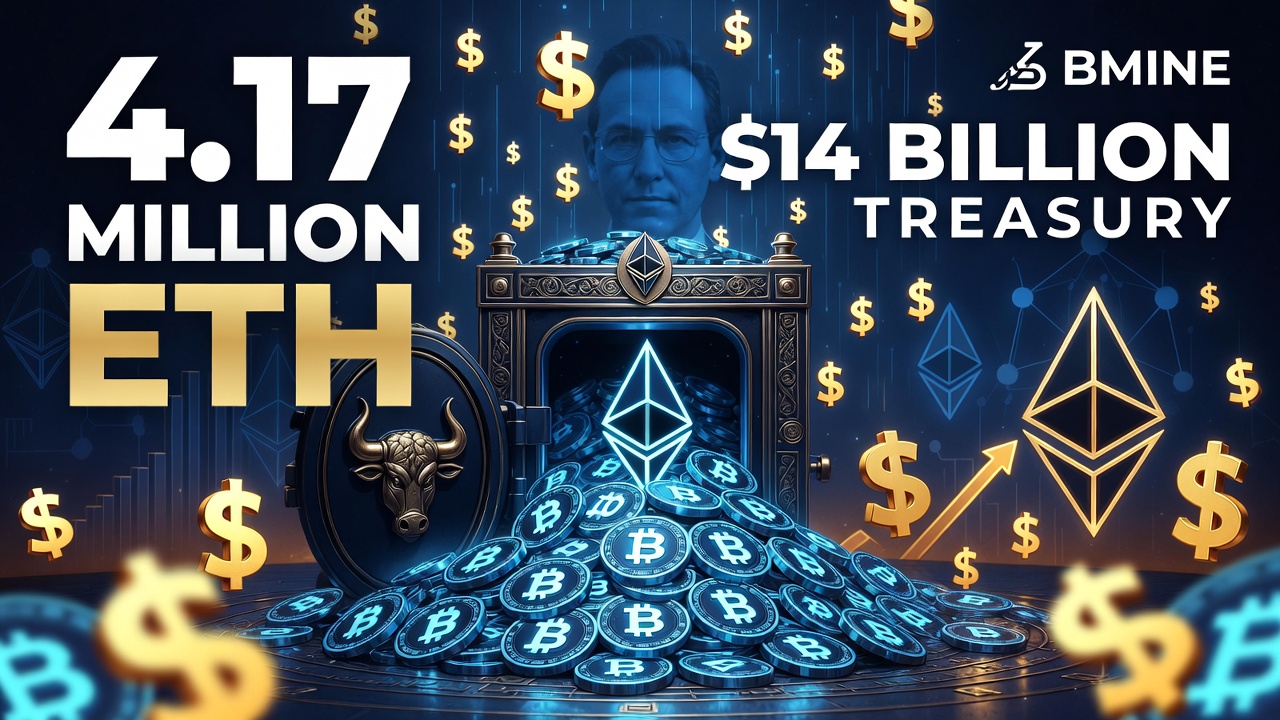
In the ever-evolving world of cryptocurrency, few stories have captured attention quite like the rise of corporate treasuries. Remember when MicroStrategy made headlines by pouring billions into Bitcoin back in 2020? Fast forward to 2026, and a similar—but distinctly Ethereum-focused—revolution is underway, led by Bitmine Immersion Technologies (NYSE: BMNR).
The company recently announced its Bitmine ETH holdings have surged to an astonishing 4.17 million tokens, pushing combined crypto and cash reserves to around $14 billion. With staking taking center stage, Bitmine isn’t just holding Ethereum—it’s positioning itself as the premier corporate steward of the world’s second-largest cryptocurrency.
This isn’t just another accumulation update. It’s a signal that corporate America is waking up to Ethereum’s unique advantages: programmable money, yield-generating staking, and a growing role in tokenization and decentralized finance. As Chairman Tom Lee puts it, 2026 could be the year crypto fully recovers, with Ethereum at the forefront.
Background on Bitmine Immersion Technologies
Bitmine Immersion Technologies started as a player in immersion cooling for data centers but pivoted aggressively into becoming an Ethereum treasury company in recent years. Under the leadership of renowned analyst Tom Lee, the firm has transformed into a pure-play vehicle for ETH exposure.


Unlike traditional corporations dipping toes into crypto, Bitmine’s strategy is unapologetically bold: acquire as much ETH as possible, stake it for yield, and grow ETH per share accretively. The company’s “Alchemy of 5%” goal—aiming to own 5% of all Ethereum—has already reached nearly 70% progress in just six months.
This approach mirrors MicroStrategy’s Bitcoin playbook but tailors it to Ethereum’s strengths. While Bitcoin is often called digital gold, Ethereum is the backbone of Web3, powering everything from NFTs to layer-2 scaling solutions and real-world asset tokenization. In 2026, with stablecoin adoption exploding and blockchain poised to become Wall Street’s settlement layer, Bitmine’s bet looks increasingly prescient [1].
Latest Holdings Breakdown: The Numbers Behind Bitmine ETH Holdings
As of January 11, 2026, Bitmine’s portfolio is dominated by Ethereum:
- 4,167,768 ETH – Valued at approximately $13 billion (at $3,119 per ETH on Coinbase).
- Represents 3.45% of total ETH supply (circulating supply around 120.7 million tokens).
- Additional assets: 193 BTC, a $23 million stake in Eightco Holdings, and $988 million in cash—bringing total crypto and cash holdings to $14 billion[2].
In the past week alone, Bitmine added 24,266 ETH while increasing its cash position by $73 million—a testament to disciplined equity issuance at premiums to net asset value (NAV) [3].
To answer a common search query: How much ETH does Bitmine hold in 2026? As of January 11, 2026, Bitmine Immersion Technologies holds 4,167,768 ETH, representing 3.45% of the total Ethereum supply and valued at approximately $13 billion at current prices of around $3,119 per ETH.
Bitmine’s Aggressive ETH Accumulation Strategy
Bitmine’s accumulation isn’t random—it’s methodical. The firm positions itself as the world’s largest “fresh money” buyer of ETH, issuing shares selectively only at premiums to maintain shareholder value.
Why Ethereum over Bitcoin in 2026? Tom Lee highlights Ethereum’s role in stablecoins and tokenization, predicting blockchain will underpin Wall Street settlements. Post-2025’s “mini crypto winter,” Lee sees stronger gains ahead in 2027-2028 [4].
The path to the “Alchemy of 5%”—owning 5% of ETH supply—remains the north star. At current pace, full achievement could create significant supply dynamics, especially as more ETH gets locked in staking.
The Growing Role of Staking in Bitmine’s Portfolio
Staking is where Bitmine truly differentiates itself. As of mid-January 2026, the company has staked 1,256,083 ETH (about $3.9 billion), up nearly 600,000 ETH in a single week [5].
Current composite Ethereum staking rate (CESR) sits at 2.81%, but at full scale, Bitmine projects annual staking fees exceeding $374 million—or over $1 million per day [6].
Enter MAVAN (Made in America Validator Network): Bitmine’s proprietary staking infrastructure, set for commercial launch in Q1 2026. Working with partners, MAVAN aims to make Bitmine the largest staking provider in crypto, offering secure, U.S.-based validation [7].
Staking yields in 2026 hover around 2.5-3%, down from prior years due to increased participation but still attractive compared to traditional fixed income [8]. For corporations, this passive income stream turns idle holdings into revenue generators—something Bitcoin can’t match without third-party lending risks.
Comparison: Bitmine vs. MicroStrategy as Treasury Pioneers
Corporate crypto treasuries have come a long way. Here’s a snapshot of the leaders in early 2026:
| Company | Primary Asset | Holdings | % of Total Supply | Approx. Value | Key Strategy |
|---|---|---|---|---|---|
| Bitmine Immersion (BMNR) | ETH | 4.17 million ETH | 3.45% | $13 billion | Staking + MAVAN yield |
| MicroStrategy/Strategy | BTC | ~687,000 BTC | ~3.27% | Varies (high) | Pure holding, equity raises |
| SharpLink Gaming | ETH | ~863,000 ETH | <1% | ~$2.7 billion | Smaller-scale accumulation |
| Others (e.g., Bit Digital) | ETH | Varies | <0.5% | <$2 billion | Staking-focused |
Bitmine ranks as the #1 Ethereum treasury and #2 overall crypto treasury globally [9]. While MicroStrategy pioneered the model with Bitcoin, Bitmine adds a yield layer that’s increasingly appealing in a maturing market [10].
Market Implications of Bitmine $14 Billion Holdings
Bitmine’s scale matters. Holding 3.45% of ETH—and pushing toward 5%—could contribute to supply squeezes, especially as staking locks up more tokens. With institutional demand rising for compliant yield, Ethereum’s narrative as “ultra-sound money” strengthens.
Broader trends support this: Tokenization of real-world assets, stablecoin growth, and layer-2 adoption all favor Ethereum. Analysts see corporate Ethereum treasuries as the next wave after Bitcoin’s dominance [11].
Bitmine’s liquidity—average daily dollar volume of $1.3 billion—also provides retail and institutional investors accessible exposure without direct custody headaches.
Risks and Outlook: A Balanced View
No strategy is without risks. Share dilution remains a concern; Bitmine’s upcoming January 15, 2026, shareholder vote on increasing authorized shares is critical. Without approval, accumulation could slow dramatically [12].
Volatility, regulatory scrutiny (e.g., SEC views on staking), and Ethereum network risks persist. If prices drop sharply, NAV pressure could intensify.
Yet the upside is compelling. With MAVAN launching soon, potential dividends (Bitmine recently declared its first), and Tom Lee’s bullish outlook, the firm is well-positioned.
In conclusion, Bitmine’s ascent to the largest ETH corporate holder marks a pivotal moment for corporate Ethereum accumulation. As 2026 unfolds, watch closely—whether through direct ETH ownership or BMNR shares, this treasury powerhouse could define the next chapter of institutional crypto adoption.
Cited Sources
- PRNewswire – Bitmine ETH Holdings Update
- CoinDesk – Bitmine Adds 24,000 ETH
- Yahoo Finance – Bitmine Amasses 4.17M ETH
- PRNewswire – Tom Lee Quotes
- CryptoBriefing – Staking Update
- PRNewswire – Yield Projections
- Yahoo Finance – MAVAN Launch
- CoinDesk – Staking Yields 2026
- PRNewswire – Treasury Ranking
- CoinDesk – Comparison to MicroStrategy
- Yahoo Finance – Tom Lee’s Purchases
- CoinDesk – Shareholder Vote Warning
Discover more from The CoinStar
Subscribe to get the latest posts sent to your email.

A widespread Cloudflare outage disrupted access to X (formerly Twitter), ChatGPT, and other major platforms, echoing last month’s AWS downtime.
What Happened?
On Tuesday, November 18, 2025, Cloudflare confirmed a global service degradation that left millions of users unable to access popular websites. Platforms including X (formerly Twitter), ChatGPT, Perplexity, Letterboxd, and Downdetector were among those affected.
The company’s official status page reported “widespread 500 errors” and failures across its dashboard and API. Cloudflare engineers said they were working to restore services, noting that some recovery was underway but error rates remained higher than normal.
Impact on Websites
- Social media disruption: X timelines froze, leaving users unable to refresh feeds or post updates.
- AI platforms hit: ChatGPT and Perplexity experienced downtime, frustrating millions who rely on them for daily tasks.
- Global reach: Reports of outages came from the US, UK, Pakistan, Kenya, and Bangladesh, highlighting the scale of the incident.
Comparison to AWS Outage
The outage comes just weeks after Amazon Web Services (AWS) suffered a major disruption, which also took large portions of the internet offline. Together, these incidents underscore the fragility of global internet infrastructure, where a single provider’s failure can ripple across industries.
Expert Reactions
Cybersecurity analysts warn that concentration of internet traffic through a handful of providers creates systemic risk. Cloudflare, like AWS, plays a critical role in shielding websites from cyberattacks and managing traffic loads. When these networks falter, the consequences are immediate and widespread.
What’s Next
Cloudflare has assured users that remediation efforts are ongoing and services are gradually recovering. However, the outage raises pressing questions about redundancy, resilience, and the need for diversified internet infrastructure.
Discover more from The CoinStar
Subscribe to get the latest posts sent to your email.
-

 AI4 months ago
The Chatbot Era is Over: Why OpenAI’s Pivot to Hardware with Foxconn Changes Everything
-

 AI5 months ago
The Top 10 Performing Crypto Coins in 2025: The Definitive Analyst Report on Price Potential, AI Integration, and Institutional Adoption
-

 Aviation4 months ago
Airbus A320 Recall: A Crisis of Confidence in Global Aviation
-

 AI3 months ago
Bitcoin Poised For ‘Boring’ 2025 Close – Here’s When BTC’s Real Test Will Come
-

 AI4 months ago
How AI-Driven Tokens Are Reshaping DeFi in 2025
-

 News4 months ago
Apple Pocket: The Most Controversial Tech Accessory
-

 Acquisition4 months ago
Daily Mail Owner Strikes £500m Deal for Telegraph Amid Regulatory Scrutiny
-

 Business4 months ago
Cloudflare Down: Twitter, ChatGPT, and Major Websites Hit by Global Internet Outage

